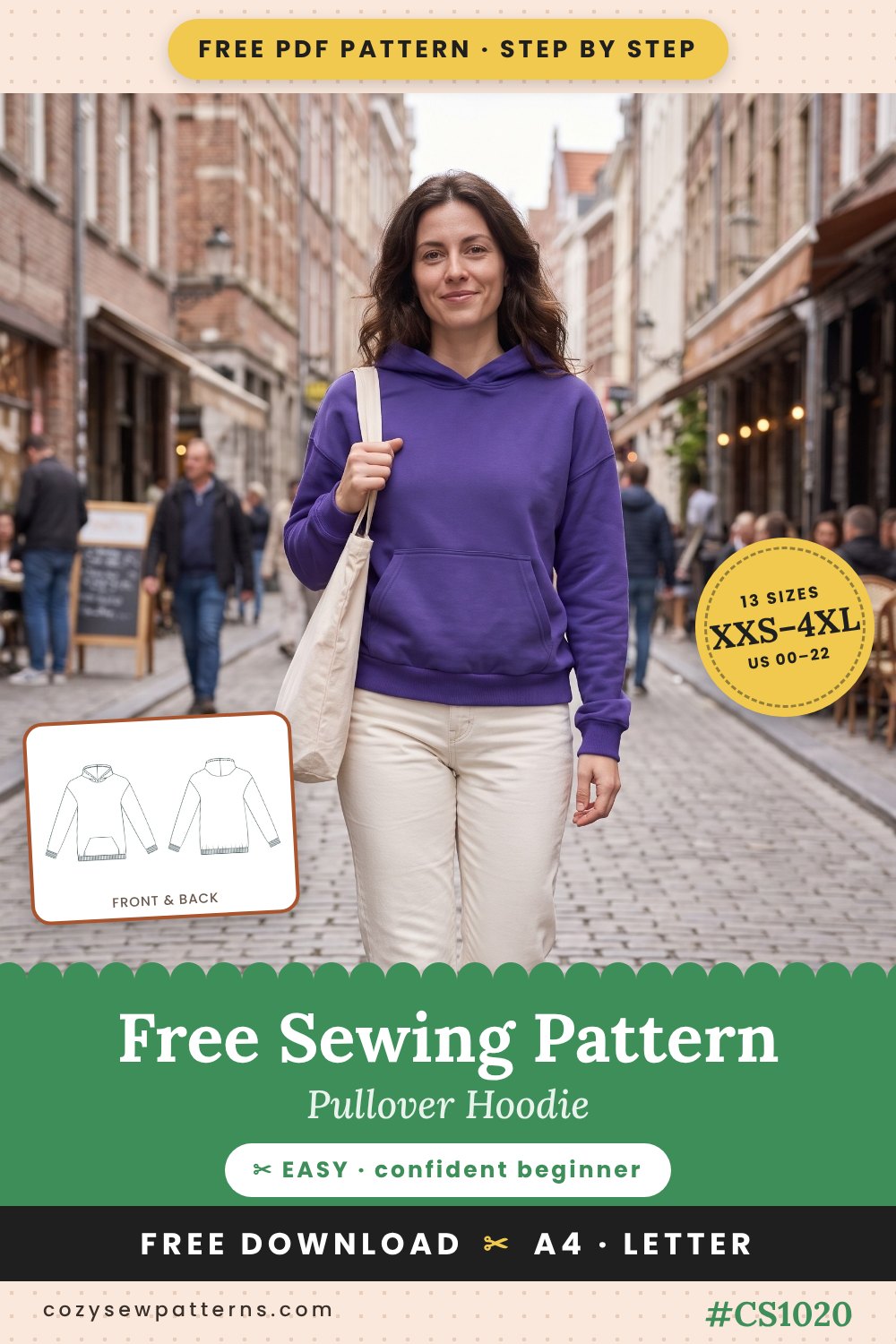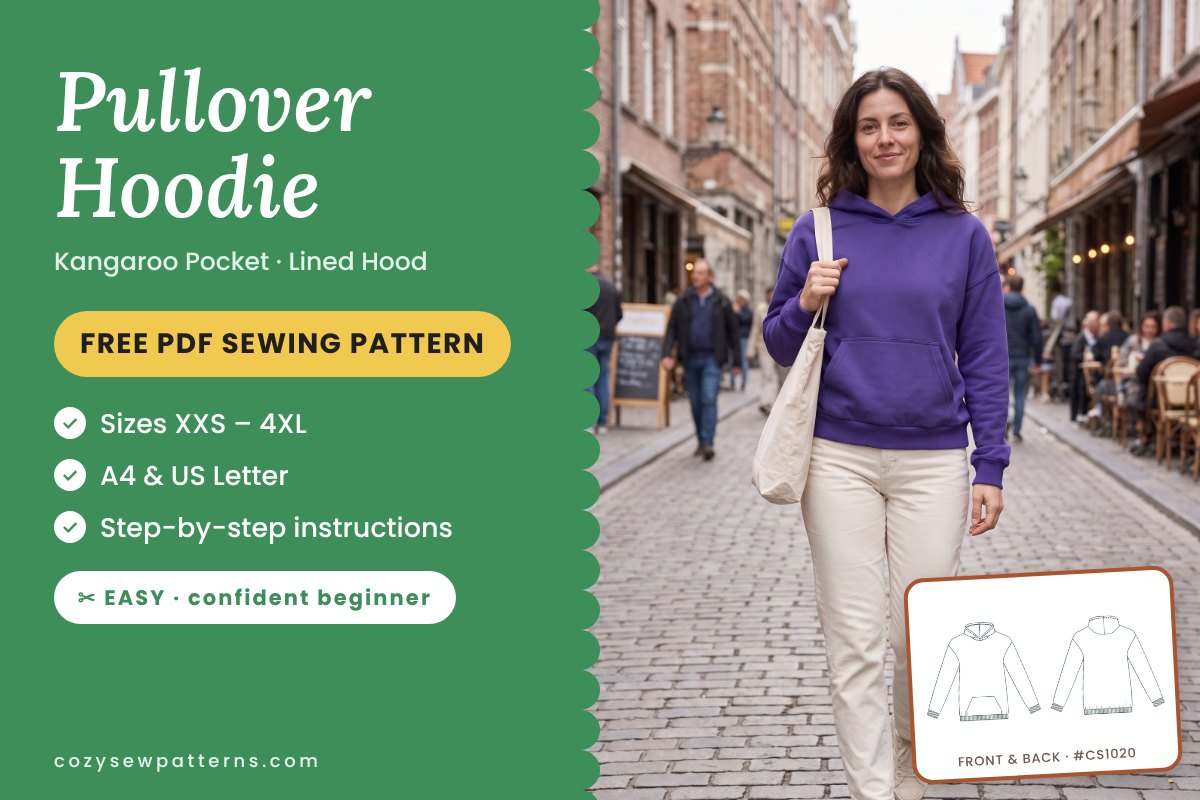
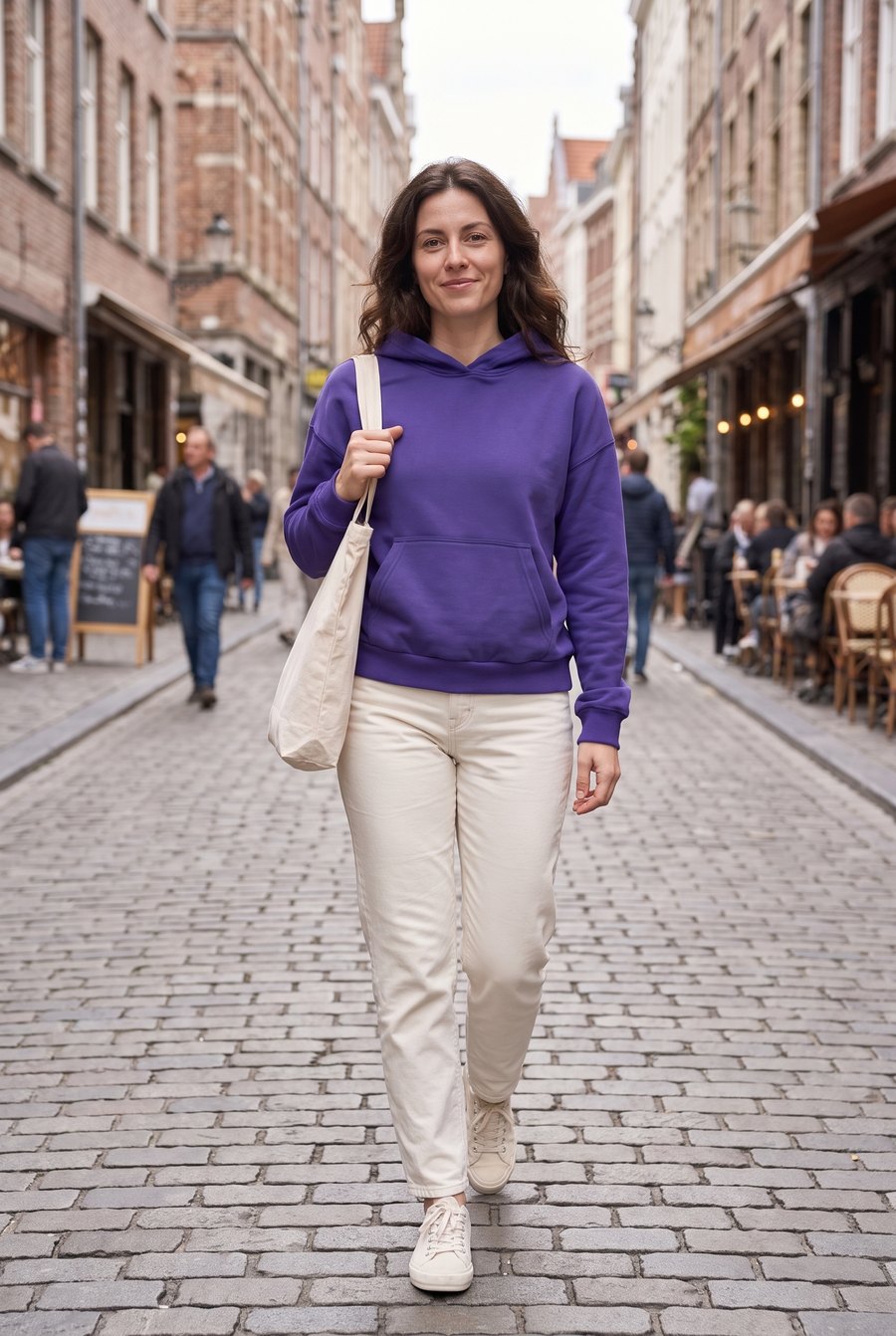
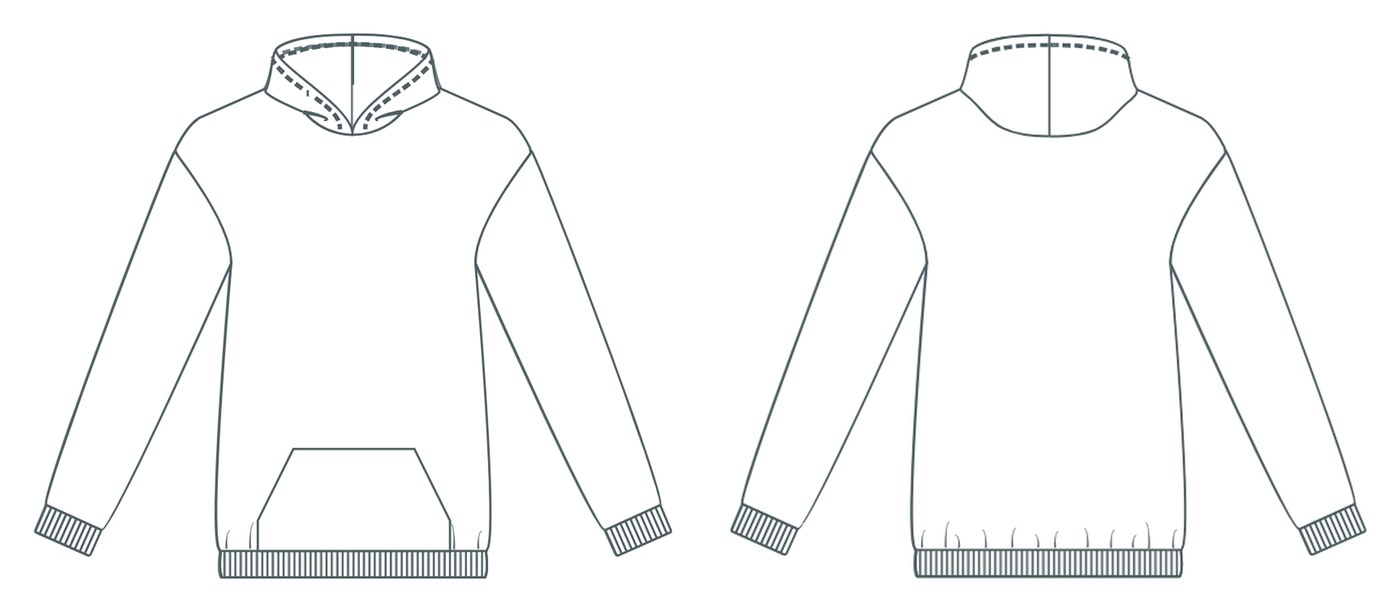
A cosy everyday pullover hoodie with a relaxed fit and dropped shoulders. The roomy hood is lined in the same fabric, so it looks neat from every side, and its front edges meet in a soft V at the centre front. A big kangaroo pocket with slanted hand openings sits on the front, and rib cuffs and a rib waistband hug the wrists and the low hip. Front and back are cut in one piece with no centre seams, which makes this a quick and satisfying knit project: sew it in sweatshirt fleece for winter, in French terry for spring, or make a matching one for someone you love.
Download the free PDF sewing pattern in A4 and US Letter, in 13 sizes from XXS to 4XL (US 00–22, plus sizes included), and sew your own hoodie!
Materials
- Main fabric (knit, at least 50% widthwise stretch): 1.5–1.7 m (1 3/4–1 7/8 yd) of 150 cm (60″) wide fabric, or 1.9–2.4 m (2 1/8–2 5/8 yd) of 115 cm (45″) wide fabric. Sweatshirt fleece, French terry, brushed-back fleece, cotton or bamboo jersey with spandex, or a soft sweater knit
- Rib knit (1×1 or 2×2, at least 50% stretch): 0.3 m (3/8 yd), 115 cm (45″) wide or more, for the cuffs and waistband
- Knit fusible interfacing: 0.1 m (1/8 yd) for the pocket openings
- Polyester all-purpose thread, a ballpoint/stretch needle 75/11 or 80/12, and a 4 mm twin stretch needle (or a narrow zigzag) for the pocket openings
- Optional: 6–10 mm (1/4–3/8″) clear elastic or stay tape for the shoulder seams
Pre-wash the main fabric and the rib the way you will wash the finished hoodie. No buttons, zips or elastic needed: a regular sewing machine is enough, and a serger is nice to have but not required.
Pattern pieces
- Front, main fabric: cut 1 (single layer, drawn whole)
- Back, main fabric: cut 1 (single layer, drawn whole)
- Sleeve, main fabric: cut 2 (a left and a right)
- Hood, main fabric: cut 4 (2 outer + 2 lining, in mirrored pairs)
- Kangaroo pocket, main fabric: cut 1
- Pocket interfacing, knit fusible interfacing: cut 2
- Waistband, rib knit: cut 1
- Sleeve cuff, rib knit: cut 2
The Front and Back are drawn as whole pieces, so cut them from a single layer of fabric, not on a fold, or they will be twice as wide. Cut the waistband and cuffs with the greatest stretch of the rib running along the long edge; they are also drawn whole and folded in half after cutting. Snip every notch and mark the pocket placement on the right side of the Front.
Download the free PDF sewing pattern
One file per size, in the paper format that suits you. Share your finished hoodie with #cozysewpatterns!
 A0 + Step-by-step guideGet it here ↓
Unzip the folder first. Print page 1 at 100% (actual size) and measure the 10 cm (4″) calibration square before printing the rest. Pages are numbered by row (1/1, 1/2, 2/1…): trim the margins, tape each row together and then join the rows. The A0 file comes with the illustrated guide below.
Design details and fit
The cosy, easy-to-wear hoodie you will reach for every day, sewn in a stretch knit. Here is what makes it:
- Fit: relaxed, slightly oversized, low-hip length
- Shoulders and sleeves: dropped shoulders and long sleeves
- Hood: two-layer hood lined in the same fabric, with a topstitched front edge
- Pocket: a big kangaroo pocket with slanted hand openings
- Bands: rib knit cuffs and waistband that hug the wrists and low hip
- Body: front and back cut in one piece, no centre seams
The hoodie has about 19–24 cm (7 1/2–9 1/2″) of ease at the bust, so it is relaxed on purpose. If you are between sizes, the smaller one gives a neater fit.
Sizing guide
Drafted for a height of 1.68 m (5′6″). Choose your size by your bust: the hoodie has about 19–24 cm (7 1/2–9 1/2″) of ease there, so it is relaxed on purpose. Between sizes, take the smaller one for a neater fit. If your fabric is thick (heavy or sherpa-backed fleece) or you want to wear it over a warm sweater, choose one size up. To change the length, lengthen or shorten the Front and Back by the same amount at the lower edge and keep the pocket at the same distance from the hem.
Letter sizes: 00 = XXS · 0/2 = XS · 4/6 = S · 8/10 = M · 12/14 = L · 16 = XL · 18 = 2XL · 20 = 3XL · 22 = 4XL
Body measurements (cm)
| cm | 00 | 0 | 2 | 4 | 6 | 8 | 10 | 12 | 14 | 16 | 18 | 20 | 22 |
|---|---|---|---|---|---|---|---|---|---|---|---|---|---|
| Bust | 80 | 82.5 | 85 | 87.8 | 90.3 | 92.8 | 95.3 | 99.3 | 104.3 | 109.3 | 114.3 | 119.3 | 124.3 |
| Waist | 63.5 | 66 | 68.8 | 71.3 | 73.8 | 76.3 | 78.8 | 82.8 | 87.5 | 93.3 | 99 | 104.8 | 110.5 |
| Hips | 87.8 | 90.3 | 92.8 | 95.3 | 98 | 100.3 | 102.8 | 106.5 | 111 | 115.5 | 120.8 | 125.8 | 130.8 |
Body measurements (inches)
| in | 00 | 0 | 2 | 4 | 6 | 8 | 10 | 12 | 14 | 16 | 18 | 20 | 22 |
|---|---|---|---|---|---|---|---|---|---|---|---|---|---|
| Bust | 31.5 | 32.5 | 33.5 | 34.5 | 35.5 | 36.5 | 37.5 | 39.1 | 41.0 | 43.0 | 45.0 | 47.0 | 48.9 |
| Waist | 25.0 | 26.0 | 27.1 | 28.0 | 29.0 | 30.0 | 31.0 | 32.6 | 34.5 | 36.8 | 39.0 | 41.3 | 43.5 |
| Hips | 34.5 | 35.5 | 36.5 | 37.5 | 38.6 | 39.5 | 40.5 | 41.9 | 43.8 | 45.5 | 47.5 | 49.5 | 51.5 |
Finished garment measurements (cm)
| cm | 00 | 0 | 2 | 4 | 6 | 8 | 10 | 12 | 14 | 16 | 18 | 20 | 22 |
|---|---|---|---|---|---|---|---|---|---|---|---|---|---|
| Bust | 103 | 105 | 107 | 108 | 111 | 113 | 115 | 118 | 122 | 126 | 131 | 135 | 139 |
| Body hem (above band) | 96 | 98 | 100 | 102 | 105 | 107 | 109 | 113 | 118 | 123 | 128 | 133 | 138 |
| Waistband, relaxed | 76 | 77 | 79 | 80 | 83 | 84 | 86 | 89 | 93 | 97 | 101 | 105 | 109 |
| Centre back length | 64 | 64 | 64 | 64 | 64 | 64 | 65 | 65 | 65 | 66 | 66 | 67 | 67 |
| Sleeve length | 54 | 55 | 55 | 55 | 55 | 55 | 56 | 55 | 55 | 55 | 55 | 55 | 55 |
Fabric and notions per size
| Sizes 00–6 | Sizes 8–14 | Sizes 16–22 | |
|---|---|---|---|
| Main fabric, 150 cm / 60″ | 1.5 m / 1 3/4 yd | 1.6 m / 1 3/4 yd | 1.7 m / 1 7/8 yd |
| Main fabric, 115 cm / 45″ | 1.9 m / 2 1/8 yd | 2.1 m / 2 3/8 yd | 2.4 m / 2 5/8 yd |
| Rib knit, 115 cm / 45″ or wider | 0.3 m / 3/8 yd | 0.3 m / 3/8 yd | 0.3 m / 3/8 yd |
| Knit fusible interfacing | 0.1 m / 1/8 yd | 0.1 m / 1/8 yd | 0.1 m / 1/8 yd |
Common fit adjustments
- Longer or shorter: lengthen or shorten the Front and Back by the same amount at the lower edge, and keep the pocket at the same distance from the hem.
- Between sizes: choose the smaller size for a neater fit, or the larger one for a roomier, oversized look.
- Thick fabric: in heavy fleece, sherpa-backed knit or over a warm sweater, choose one size up.
- Sleeve length: compare with a hoodie you own and adjust at the lower sleeve edge before cutting; the cuffs stay the same.
Sewing notes
Fit and style
A relaxed, slightly oversized fit with dropped shoulders and long sleeves that end in snug rib cuffs. The body falls straight to the low hip and the rib waistband draws it in gently. The hood is deep enough to wear up, and its topstitched front edge keeps it crisp. Compare the finished length with a hoodie you already own before you cut.
Cutting out
Lay the knit flat on the table and never let it hang over the edge, or the pieces stretch out of shape. Cut the Front, Back and pocket from a single layer, right side up. For the sleeves and the hood, fold the fabric right sides together so you get mirror pairs; one left and one right hood piece make the outer hood, the other pair is the lining. Keep the grainline arrows parallel to the ribs of the knit.
Choosing fabric
Best fabrics: medium-weight knits with at least 50% widthwise stretch and good recovery: sweatshirt fleece, French terry (loopback), brushed-back fleece, cotton or bamboo jersey with spandex, or a soft sweater knit. Use 1×1 or 2×2 rib knit with at least 50% stretch for the cuffs and waistband.
Fabrics to avoid:
- Stable knits such as ponte or scuba: the neckline would be too tight to pull over your head
- Wovens of any kind
- Rib with little stretch, which makes tight, wavy bands
Do the stretch test: 10 cm (4″) of fabric, stretched widthwise, must reach at least 15 cm (6″) and spring back. Pre-wash the main fabric and the rib the way you will wash the hoodie.
Step-by-Step Sewing Instructions
Seam allowances are 1 cm (3/8″). Sew with right sides together using a stretch stitch, and finish the edges as you go.
- Make the kangaroo pocket and topstitch it to the front.
- Sew the shoulder seams.
- Sew in the sleeves flat, matching the notches.
- Sew the side and sleeve seams in one go.
- Attach the rib cuffs.
- Sew the lined hood and topstitch the front edge.
- Attach the hood to the neckline.
- Attach the rib waistband.
- Give it a light steam press.
Stuck on a step? Sew it with pictures.
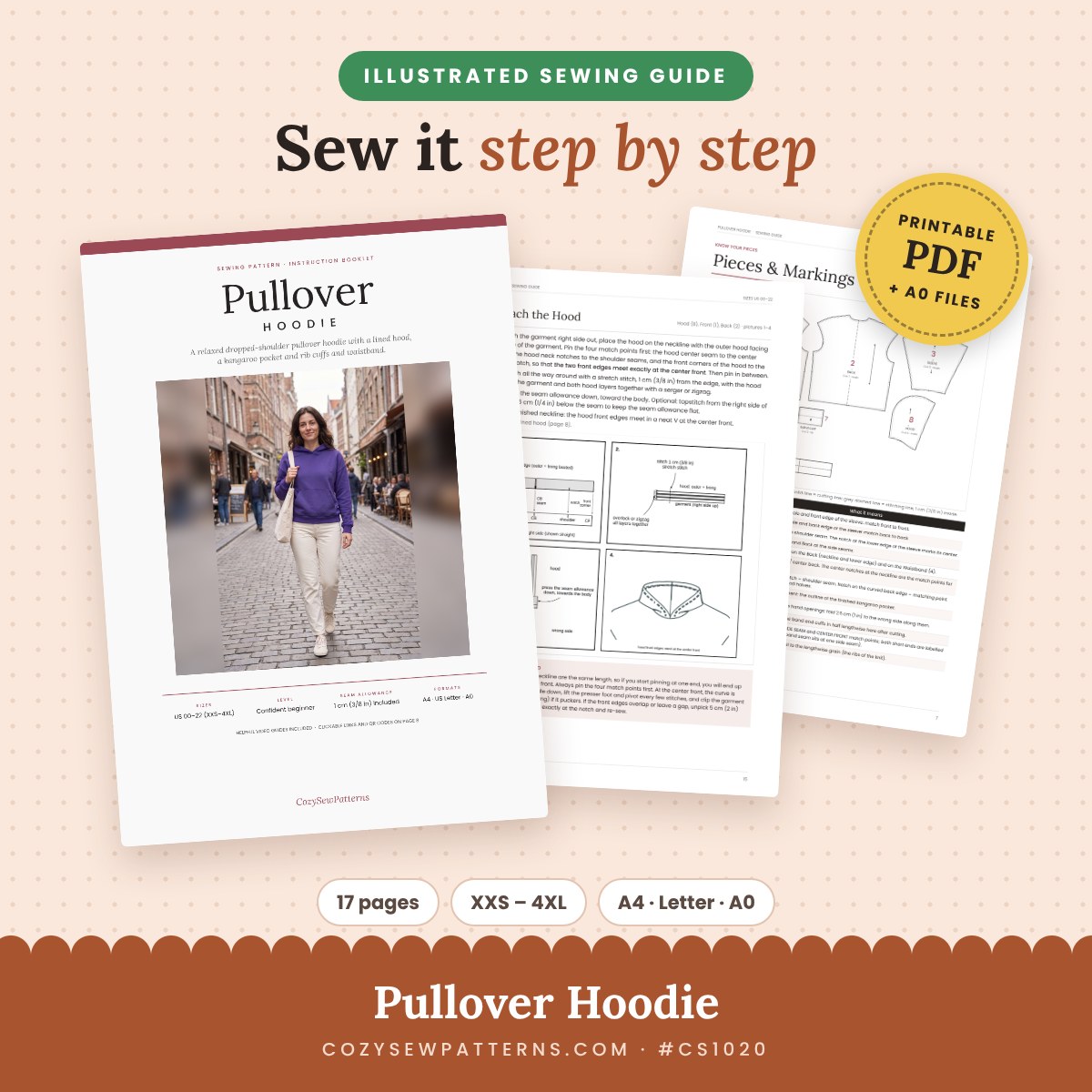
The full illustrated guide for the Pullover Hoodie shows every step in clear drawings, from the kangaroo pocket and the lined hood to the rib cuffs and waistband.
- A diagram for every step, 17 pages
- Size charts, finished measurements and fabric amounts
- Knit sewing tips + video guides with QR codes
- A0 + Step-by-step guide · instant PDF download
Español · Italiano · Deutsch · Français · Nederlands…
Buy the guide, then email us your language. Free, delivered in 48–72h.
♥ Every guide you buy keeps our patterns free.
Tips and common mistakes
- Popping seams: use a ballpoint needle with a narrow zigzag, a stretch stitch or a serger, and test on two scraps first.
- Wavy seams: do not pull the knit while you sew, and let the machine feed it.
- Hood not centred: pin the hood at the four match points before stitching it to the neckline.
- Stretched pieces: lay knits flat while cutting and never let the fabric hang off the table.
- Shiny or flat rib: press with steam by lifting and lowering the iron, never sliding it.
How to style it
- Weekend: with leggings, joggers or our free Barrel Leg Pants.
- City look: over a long-sleeve tee with our High-Waisted Barrel Trousers.
- Colour ideas: a bold colour with matching or contrast rib, or a soft heather grey for a classic look.
- Matching family: sew our Kids Zip-Up Hoodie & Sweatpants for the little ones.
Care
Wash inside out at 30 °C with similar colours. Lay flat or tumble dry low. Do not iron directly on the rib; steam it instead.
Questions
Is the pattern really free?
Yes. The A4 and US Letter pattern files in all 13 sizes are free. The illustrated step-by-step guide and the A0 files are available for a small coffee.
Is it suitable for beginners?
Yes, for confident beginners. If you have sewn a knit T-shirt or a sweatshirt before, you can sew this hoodie. The new skills are the two-layer hood, the kangaroo pocket and stretching the rib to fit. Pin the hood at the four match points first and sew slowly around the front curve.
Can I use sweatshirt fleece or sherpa?
Sweatshirt fleece and French terry are perfect. For a very thick fleece or a sherpa-backed knit, choose one size up and use a lighter knit for the hood lining if the seams get too bulky. The fabric always needs about 50% stretch so the hoodie pulls over your head.
What seam allowance is included?
1 cm (3/8″) on every edge. The slanted pocket openings have a 2.5 cm (1″) fold-back allowance. All are included in the pattern.
Which size should I choose?
Choose by your bust measurement. The hoodie is relaxed on purpose, so between two sizes the smaller one gives a neater fit.
Which paper sizes can I print?
A4 and US Letter are free to download, one file per size. The A0 files come with the illustrated guide.
What should I sew next?
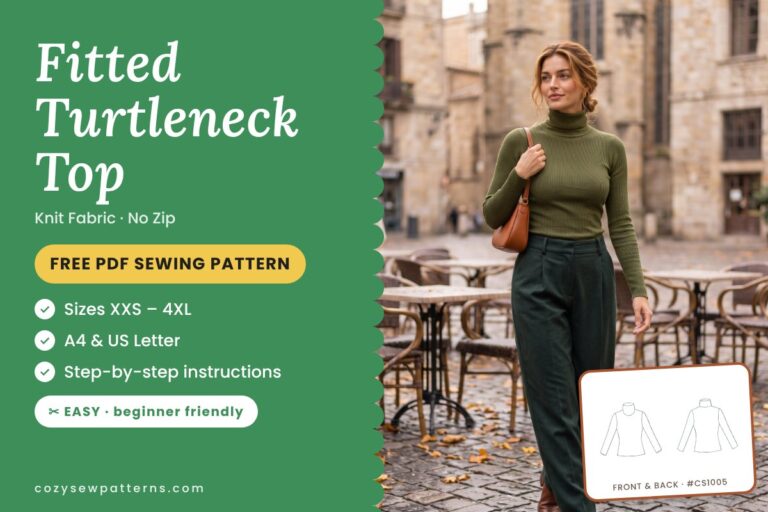
If you prefer a zip front, try our Zip-Up Bomber Sweatshirt #CS1007. For a cosy knit layer to wear underneath, the Fitted Turtleneck Top #CS1005 is a quick next project.
Happy sewing!