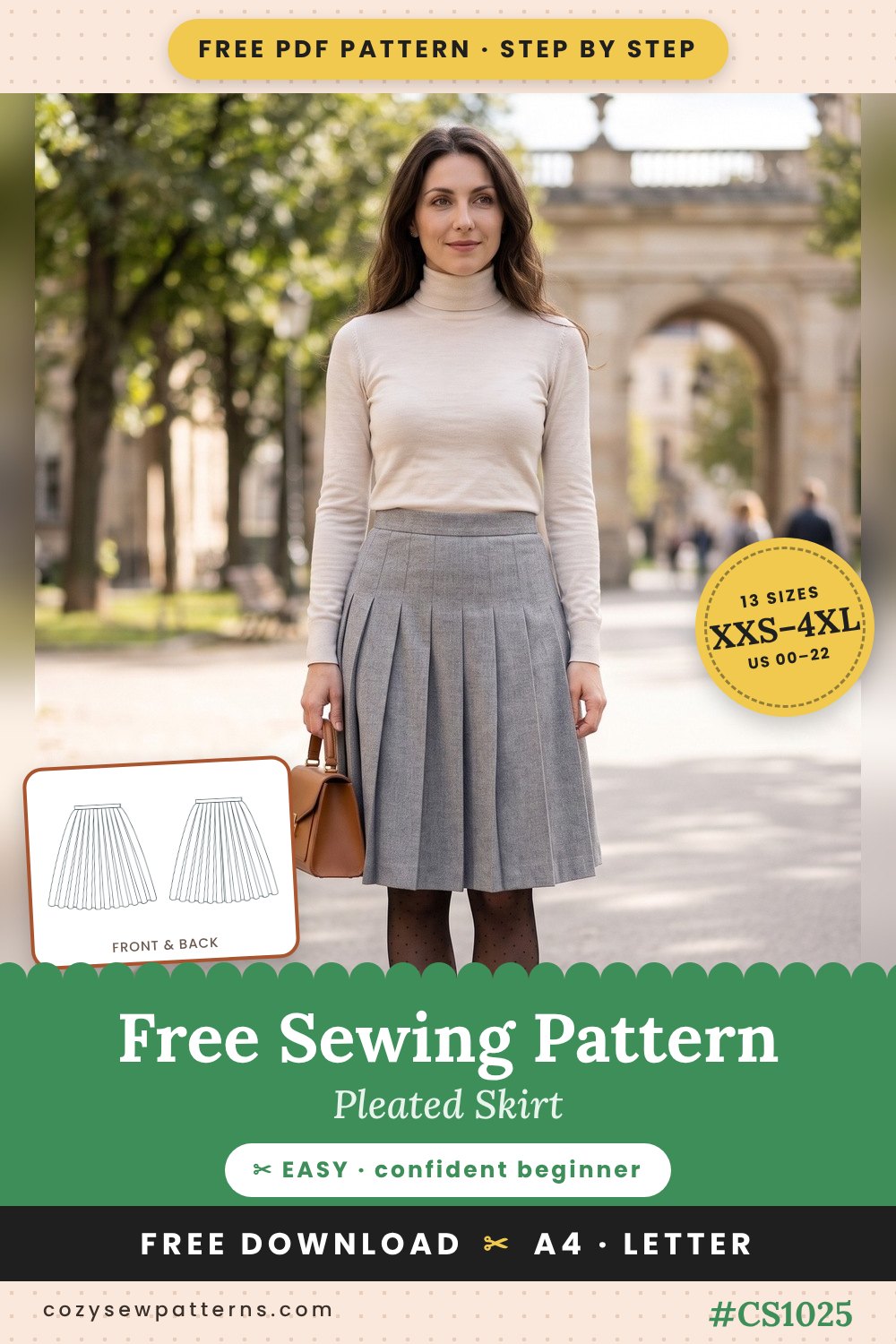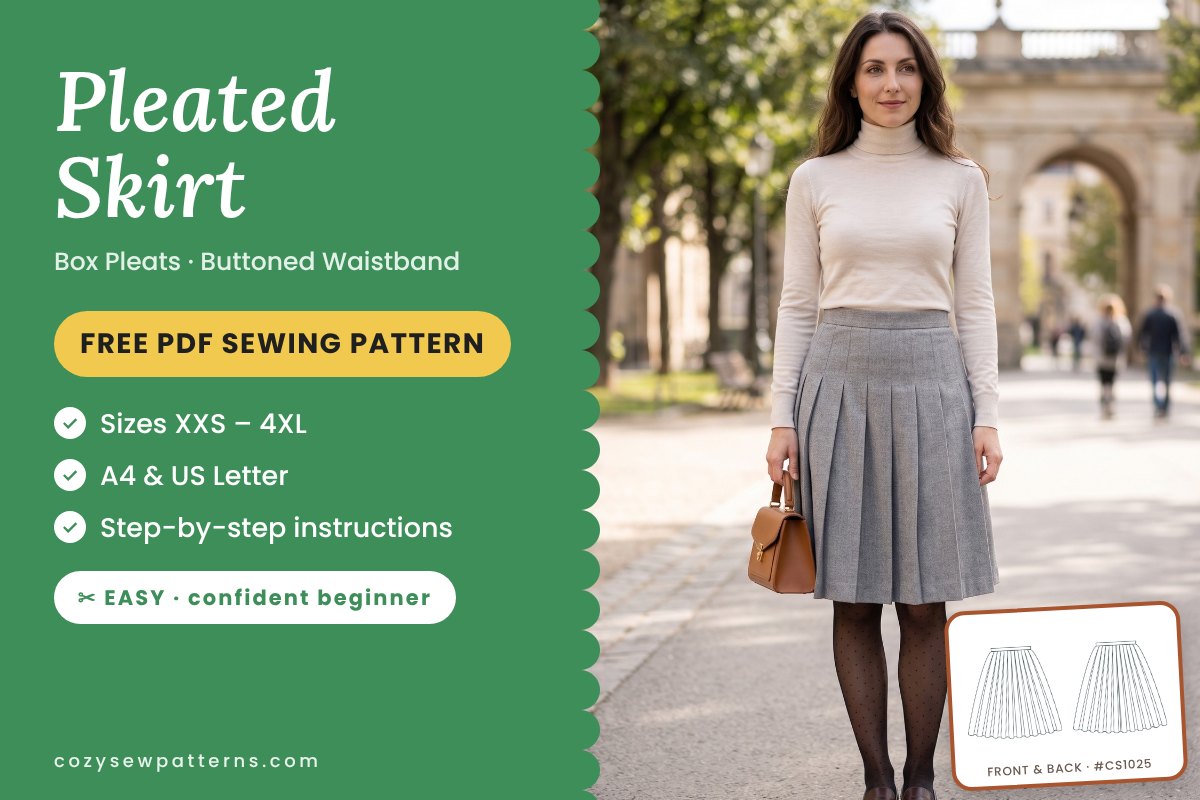
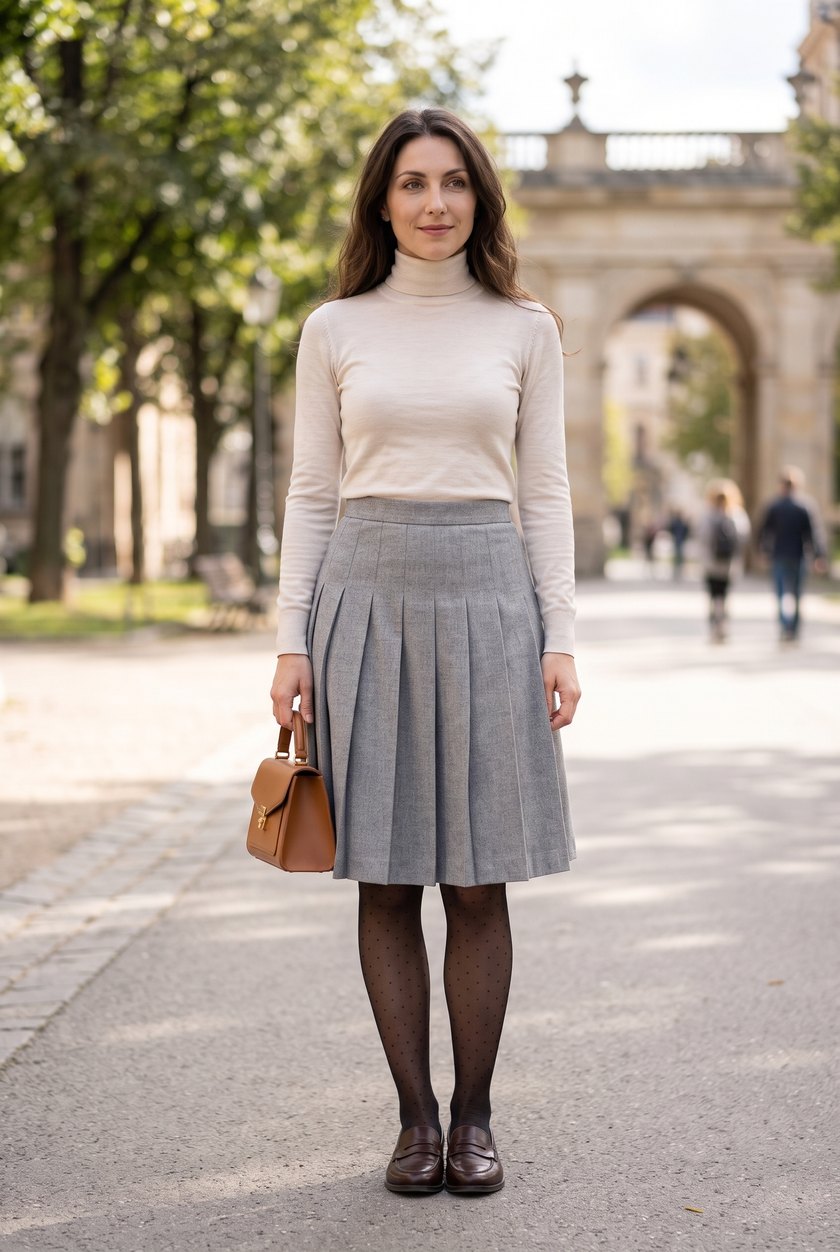
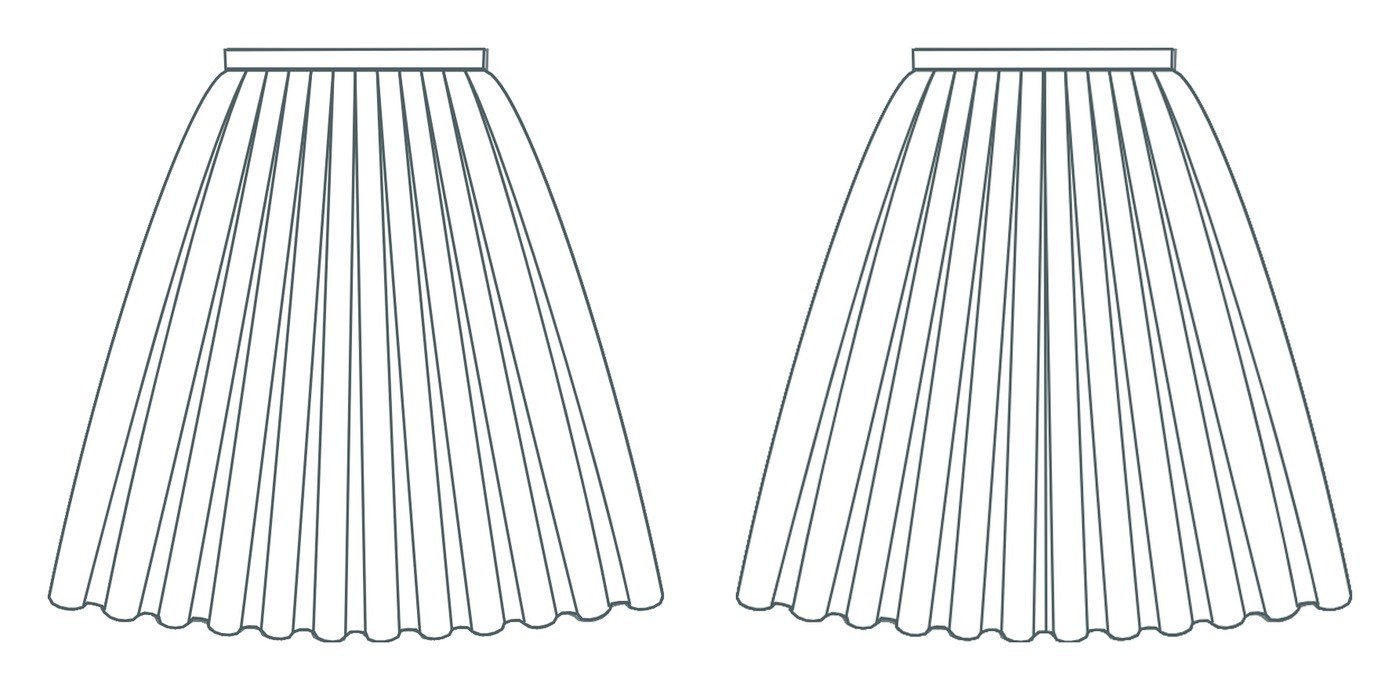
A classic knee-length skirt with twelve inverted box pleats that lie flat at the waist and swing open toward the hem. The pleats are spaced evenly all the way round, so it looks the same from the front and the back, and every seam hides inside a pleat. A straight waistband with one button closes it, and the invisible zipper in the left side is tucked under a pleat where nobody sees it. Sew it in grey wool flannel for winter with tights and a turtleneck, or in tartan for the holidays.
Download the free PDF sewing pattern in A4 and US Letter, in 13 sizes from XXS to 4XL (US 00–22, plus sizes included), and sew your own box pleated skirt!
Materials
- Main fabric: 1.4 m (1 5/8 yd) of 150 cm (60″) wide fabric for sizes 00–14, 2.6 m (2 7/8 yd) for sizes 16–22; or 2.7 m (3 yd) of 115 cm (45″) wide fabric for all sizes. A medium-weight woven that holds a sharp crease: wool flannel, wool or wool-blend suiting, tartan, gabardine, cotton twill or sateen, a linen blend or a light tweed
- 1 invisible zipper, 20 cm (8″) long (the opening is 16–18 cm / 6 1/4–7 1/8″)
- 1 button, 1 cm (3/8″) across, or a skirt hook and eye
- Medium fusible interfacing, 90 cm (36″) wide: 0.9–1.3 m (1–1 1/2 yd), cut as one long strip
- Matching all-purpose thread, an invisible zipper foot and a regular zipper foot, tailor’s chalk and a pressing cloth
Fold and press a pleat in a scrap first: the fabric must keep a sharp crease. Soft jersey and slippery polyester give puffy pleats, and very thick coating is too bulky at the waistband.
Pattern pieces
- Waistband, main fabric + interfacing: cut 1 + 1
- Skirt Right Front, main fabric: cut 1
- Skirt Left Front, main fabric: cut 1
- Skirt Right Back, main fabric: cut 1
- Skirt Left Back, main fabric: cut 1
The four skirt panels are rectangles of the same shape, printed whole: cut them on a single layer, never on a fold. Label each panel with its number as soon as it is cut, and chalk “A” and “B” on its two long edges so you join them the right way. Snip every notch at the waist: each one marks a fold line or a placement point.
Download the free PDF sewing pattern
One file per size, in the paper format that suits you. Share your finished skirt with #cozysewpatterns!
 A0 + Step-by-step guideGet it here ↓
Unzip the folder first. Print page 1 at 100% (actual size) and measure the 10 cm (4″) calibration square before printing the rest. Trim the margins and tape the pages together, matching the markers. The A0 file comes with the illustrated guide below.
Watch the pleated skirt
Design details and fit
A timeless pleated skirt with a smooth waist and plenty of movement at the hem. Here is what makes it:
- Silhouette: fitted at the waist, softly flared toward the hem as the pleats open
- Length: knee length, about 59 cm (23 1/4″) from the top of the waistband
- Pleats: twelve inverted box pleats: at center front, center back, each side and two more in every panel
- Seams: four seams, all hidden inside the pleats
- Closure: an invisible zipper in the left side, covered by the side pleat, and a 3 cm (1 1/8″) waistband with one button
- Option: stitch the pleats down 10 cm (4″) from the waist for a slim line over the hips, as in the photo
- Inside: unlined, no darts, no pockets
The waist is fitted with only 1.5–2 cm (5/8–3/4″) of ease, while the hips are roomy because the pleats open below the waistband.
Sizing guide
Drafted for a height of 1.68 m (5′6″). Choose your size by your waist measurement: the waistband is the only fitted part. Between sizes, take the larger one. With a thick wool or tweed, go one size up, because up to four layers stack inside each pleat at the waist.
Letter sizes: 00 = XXS · 0/2 = XS · 4/6 = S · 8/10 = M · 12/14 = L · 16 = XL · 18 = 2XL · 20 = 3XL · 22 = 4XL
Body measurements (cm)
| cm | 00 | 0 | 2 | 4 | 6 | 8 | 10 | 12 | 14 | 16 | 18 | 20 | 22 |
|---|---|---|---|---|---|---|---|---|---|---|---|---|---|
| Waist | 63.5 | 66 | 68.8 | 71.3 | 73.8 | 76.3 | 78.8 | 82.8 | 87.5 | 93.3 | 99 | 104.8 | 110.5 |
| Hips | 87.8 | 90.3 | 92.8 | 95.3 | 98 | 100.3 | 102.8 | 106.5 | 111 | 115.5 | 120.8 | 125.8 | 130.8 |
Body measurements (inches)
| in | 00 | 0 | 2 | 4 | 6 | 8 | 10 | 12 | 14 | 16 | 18 | 20 | 22 |
|---|---|---|---|---|---|---|---|---|---|---|---|---|---|
| Waist | 25.0 | 26.0 | 27.1 | 28.1 | 29.0 | 30.0 | 31.0 | 32.6 | 34.4 | 36.7 | 39.0 | 41.2 | 43.5 |
| Hips | 34.5 | 35.5 | 36.5 | 37.5 | 38.6 | 39.5 | 40.5 | 41.9 | 43.7 | 45.5 | 47.5 | 49.5 | 51.5 |
Finished garment measurements (cm)
| cm | 00 | 0 | 2 | 4 | 6 | 8 | 10 | 12 | 14 | 16 | 18 | 20 | 22 |
|---|---|---|---|---|---|---|---|---|---|---|---|---|---|
| Waist | 64.8 | 67.3 | 70.1 | 72.7 | 75.2 | 77.8 | 80.3 | 84.4 | 89.2 | 95.1 | 101 | 106.8 | 112.7 |
| Hips* | 90.4 | 93 | 95.5 | 98.1 | 101 | 103.3 | 105.9 | 109.8 | 114.6 | 120.2 | 126.4 | 132.4 | 138.5 |
| Hem width | 107.4 | 109.4 | 111.7 | 114 | 116.6 | 118.7 | 120.7 | 124.3 | 128.5 | 133.4 | 139.1 | 144.7 | 150.4 |
| Length** | 59.2 | 59.1 | 59.1 | 59.1 | 59 | 59 | 58.8 | 59 | 58.9 | 58.7 | 58.6 | 58.6 | 58.5 |
Fabric and notions per size
| Sizes 00–6 | Sizes 8–14 | Sizes 16–22 | |
|---|---|---|---|
| Main 150 cm / 60″ | 1.4 m / 1 5/8 yd | 1.4 m / 1 5/8 yd | 2.6 m / 2 7/8 yd |
| Main 115 cm / 45″ | 2.7 m / 3 yd | 2.7 m / 3 yd | 2.7 m / 3 yd |
| Interfacing 90 cm / 36″ | 0.9 m / 1 yd | 1.1 m / 1 1/4 yd | 1.3 m / 1 1/2 yd |
| Invisible zipper | 20 cm (8″) | 20 cm (8″) | 20 cm (8″) |
| Button 1 cm (3/8″) | 1 | 1 | 1 |
Common fit adjustments
- Longer or shorter skirt: the panels are rectangles, so add or remove paper at the hem edge, the same amount on all four panels.
- Waistband a little too long: up to 1 cm (3/8″) can be eased in; more than that means a pleat is folded off its line, so check the pleats first.
- Thick fabric: choose one size up so the layers inside the pleats do not tighten the waist.
- Smoother hips: edgestitch each pleat fold from the waist down 10 cm (4″), leaving the pleat over the zipper free.
Sewing notes
Fit and style
The pleats are made with the iron, not the machine. Press every fold with steam and a pressing cloth, let the fabric cool flat before you move it, and press again after each step. Count before basting: 12 pleats, 12 equal spaces, every fold touching its partner.
Cutting out
Lay the fabric right side up in a single layer with the paper printed side up, and keep the grainline parallel to the selvage. For tartan, put the same stripe at the hem edge of all four panels so the checks run level. Chalk every fold line and underfold line on the wrong side, and finish the long edges and the lower edge of each panel while they are still flat.
Choosing fabric
Best fabrics: medium-weight wovens that hold a crisp crease: wool flannel, wool or wool-blend suiting, tartan and plaid, gabardine, cotton twill, cotton sateen, linen blends and light tweed.
Fabrics to avoid:
- Stretch knits: the pleats will not keep their shape
- Very soft or slippery fabrics, like viscose challis or satin polyester
- Thick coating or boiled wool, which is too bulky at the waistband
Pre-wash your fabric the way you will wash the finished skirt, and always test a pleat on a scrap before you cut.
Step-by-Step Sewing Instructions
Seam allowances are 1 cm (3/8″). Sew with right sides together and press every seam as you go.
- Transfer the markings and finish the panel edges.
- Sew the center front and center back seams.
- Sew the right side seam.
- Insert the invisible zipper in the left side and close the seam below it.
- Hem the skirt while it is still flat.
- Fold and press the pleats, then baste them at the waist.
- Fold the side pleat over the zipper and check the waist.
- Attach the waistband, matching its marks to the pleat lines.
- Sew the buttonhole and the button, then give the skirt a final press.
Stuck on a step? Sew it with pictures.
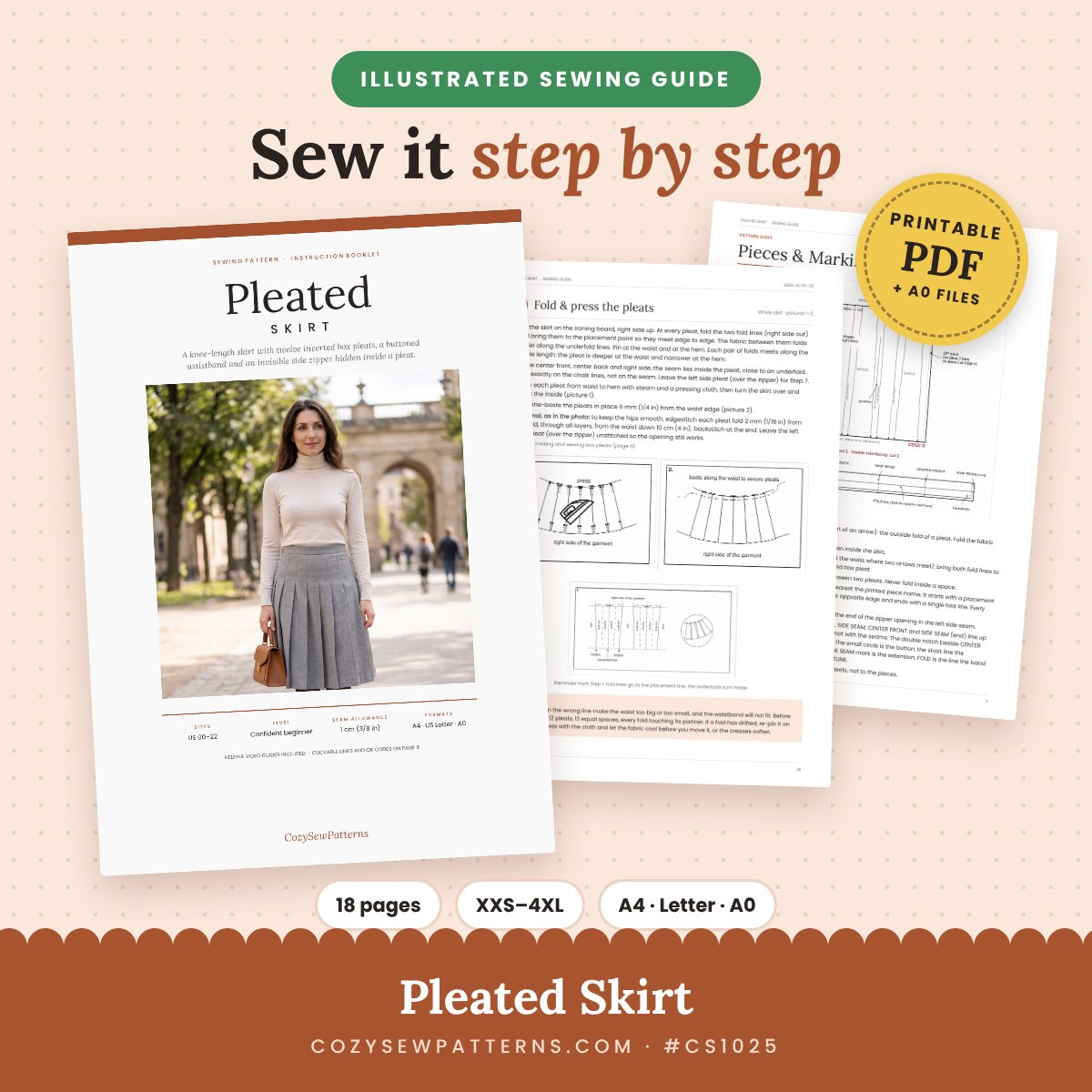
The full illustrated guide for the Pleated Skirt shows every step in clear drawings, from marking and folding the box pleats to hiding the invisible zipper and attaching the buttoned waistband.
- A diagram for every step, 18 pages
- Size charts, finished measurements and fabric amounts
- Beginner tips + video guides with QR codes
- A0 file included · instant PDF download
Español · Italiano · Deutsch · Français · Nederlands…
Buy the guide, then email us your language. Free, delivered in 48–72h.
♥ Every guide you buy keeps our patterns free.
Tips and common mistakes
- Joining the wrong edges: every seam joins an edge B to an edge A. Check the chalk letters before you stitch.
- Waistband does not fit: a pleat folded off its chalk line changes the waist. Re-pin it on the line before basting.
- Zipper showing: fold the side pleat on its chalk lines, not on the seam, so the front edge covers the zipper.
- Twisted pleats at the hem: do not stretch the hem as you sew it, and use a normal stitch length.
- Soft creases: press with steam and a cloth, then let the fabric cool completely before moving it.
How to style it
- Winter: with a tucked-in turtleneck, tights and loafers, as in the photo; try our free Fitted Turtleneck Top.
- Holidays: in tartan with a cream blouse such as our Bishop Sleeve Blouse.
- Layered: with a knit or quilted layer on top, like our Quilted Button Vest.
- Colour ideas: grey or charcoal flannel, navy, camel, or a red or green tartan.
Care
Follow the care advice of your fabric. Wool is best dry-cleaned or hand-washed cold. Re-press the pleats with steam and a pressing cloth while the skirt is still slightly damp, then hang it from the waistband.
Questions
Is the pattern really free?
Yes. The A4 and US Letter pattern files are free. The illustrated step-by-step guide and the A0 file are available for a small coffee.
Is a pleated skirt hard to sew?
It is a good project for a confident beginner. The panels are simple rectangles, and the pleats are folded and pressed with the iron. You will also learn an invisible zipper and a buttoned waistband. The side pleat over the zipper is the trickiest step, so read it before you start.
How many pleats does the skirt have?
Twelve inverted box pleats, spaced evenly all the way round, so the skirt looks the same from the front and the back.
What seam allowance is included?
1 cm (3/8″) on all seams and 2 cm (3/4″) at the hem. They are included in the pattern.
Which size should I choose?
Choose by your waist measurement, because the waistband is the fitted part. Between two sizes take the larger one, and go one size up for thick wool.
Which paper sizes can I print?
A4 and US Letter are free to download, one file per size. The A0 file comes with the illustrated guide.
What should I sew next?
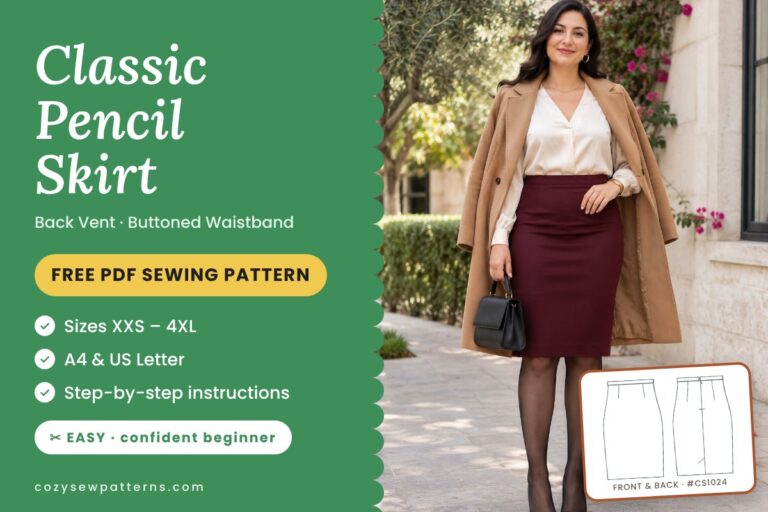
For a different skirt shape, try our Classic Pencil Skirt #CS1024, and top it with the Fitted Turtleneck Top #CS1005, free too.
Happy sewing!