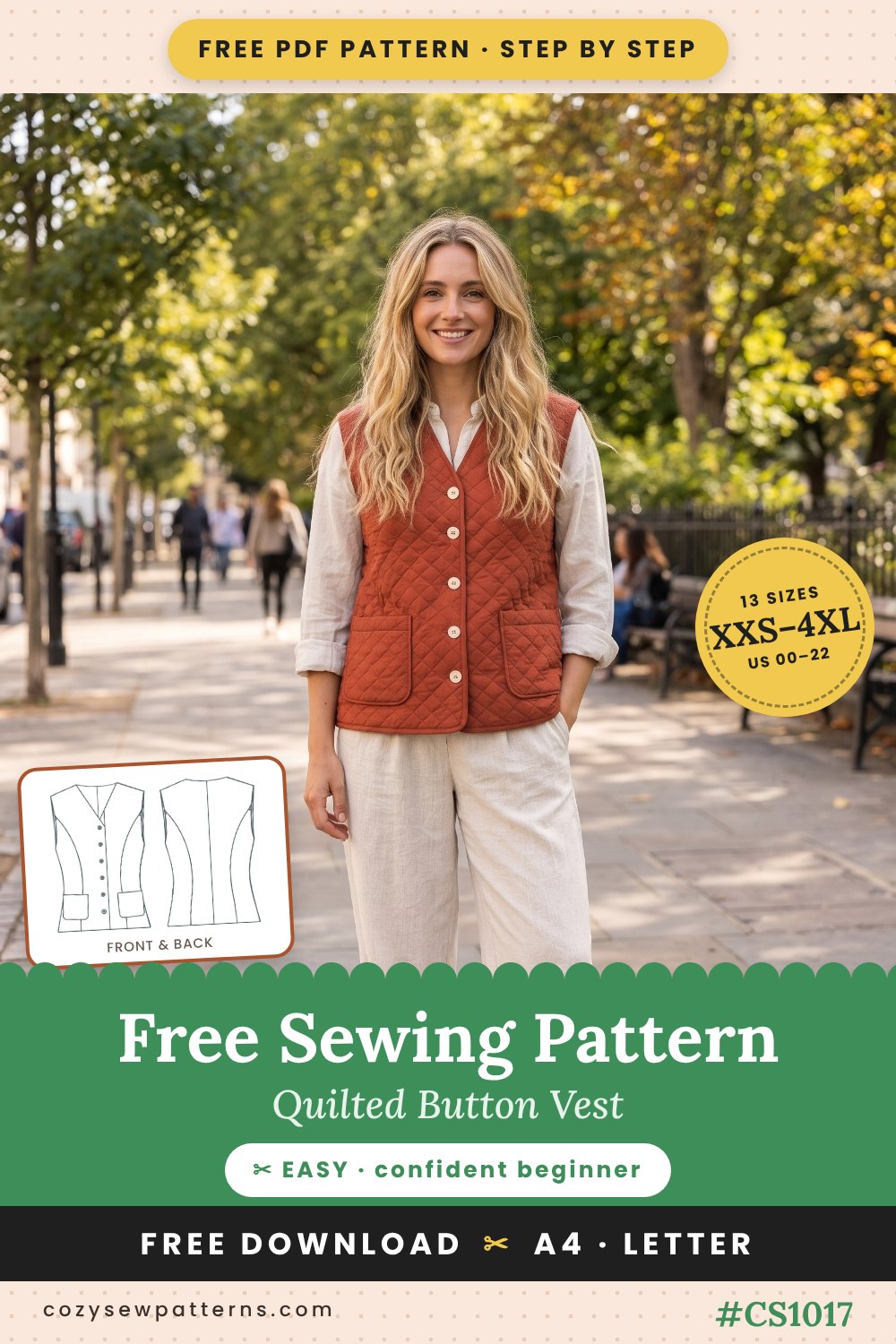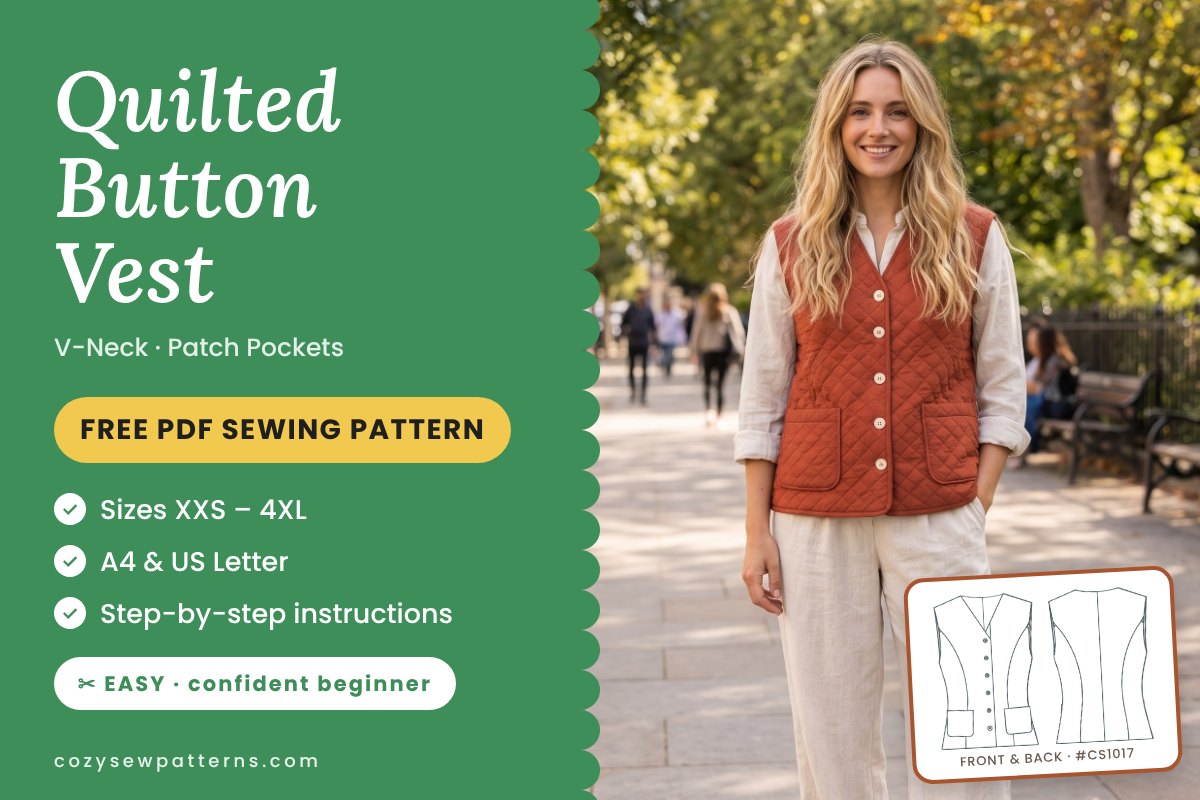
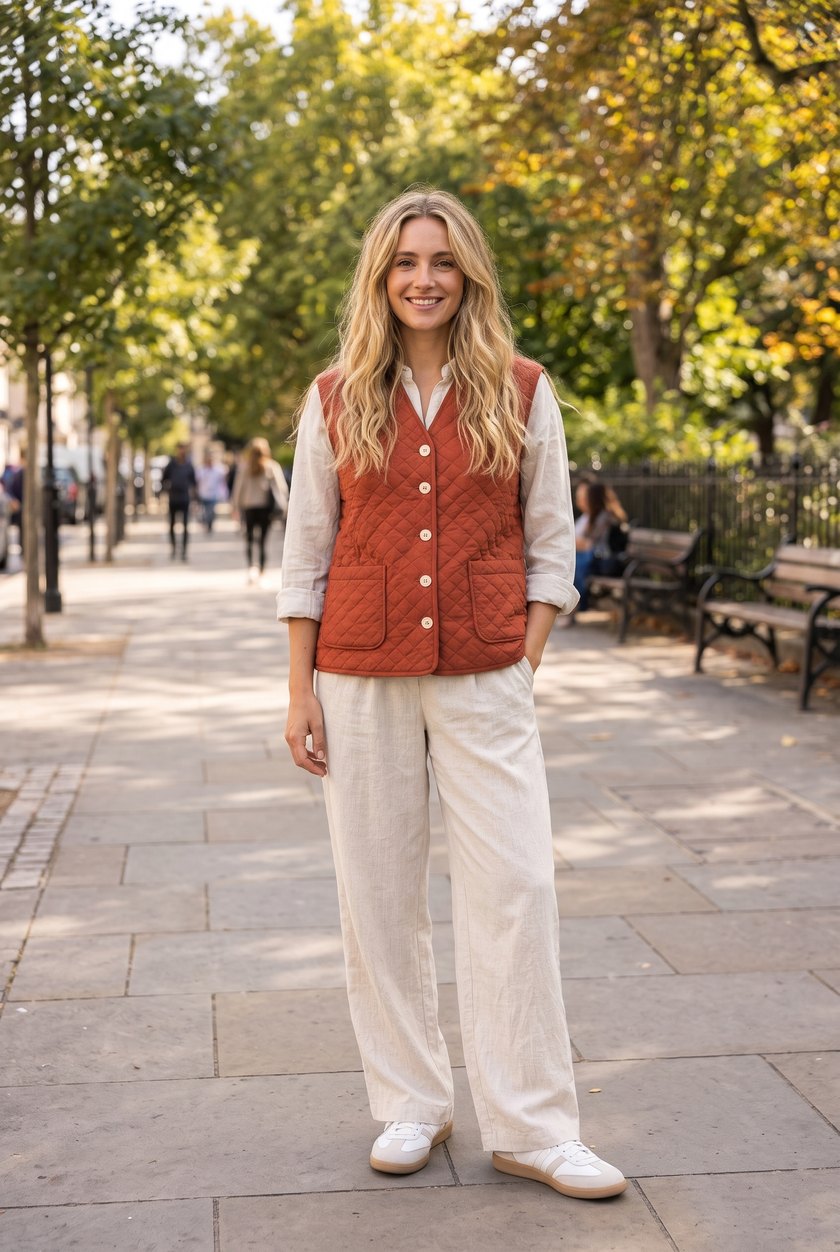
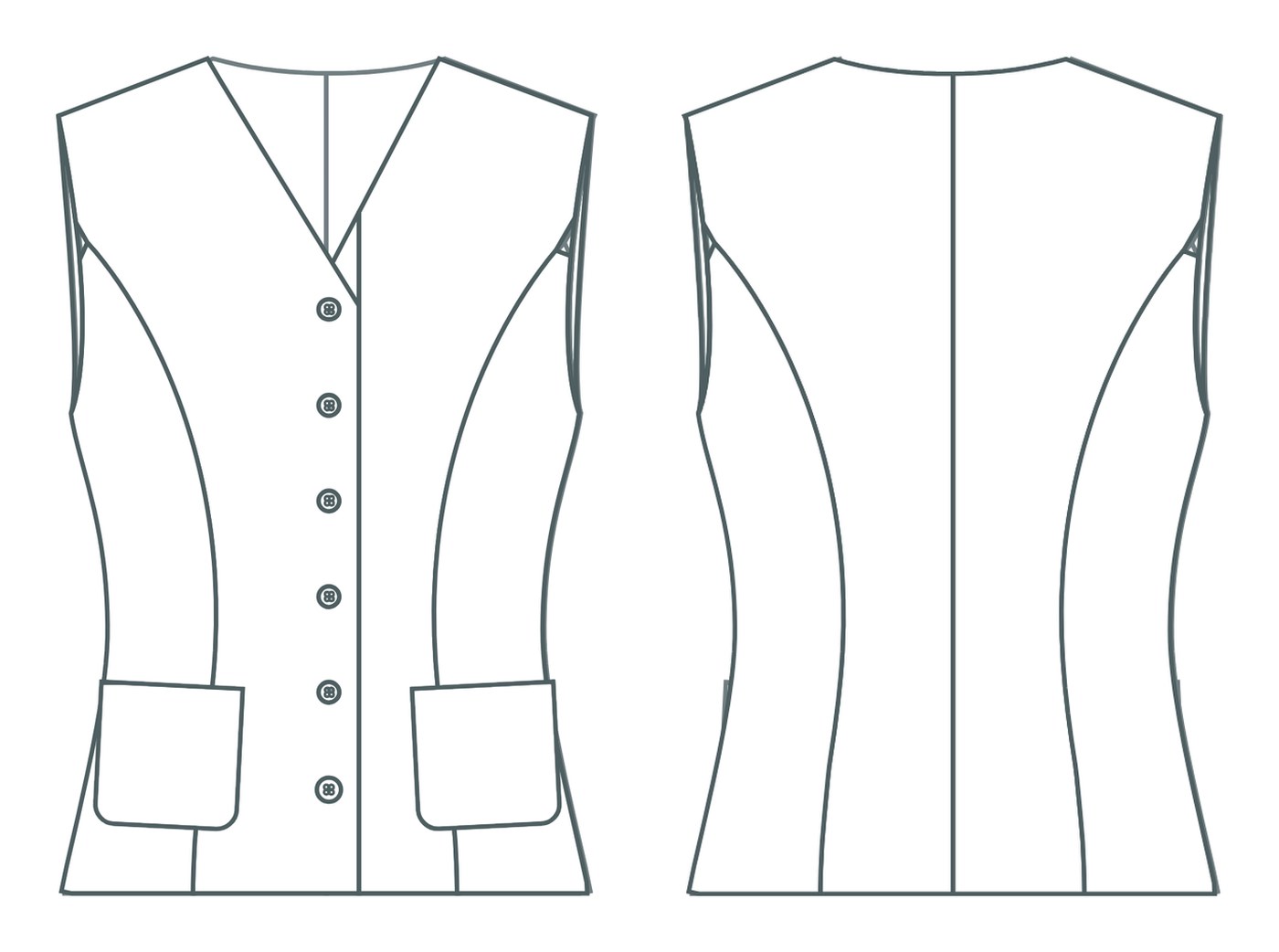
A cosy, hip-length quilted vest made from pre-quilted fabric, so it is warm without any lining. Princess seams at the front and back give it a soft, flattering shape, the V-neckline closes over a row of six buttons, and two roomy patch pockets with rounded corners sit across the front seams. The neckline and armholes are finished with interfaced facings, so there is no collar and no sleeve to set in: a quick, satisfying project. Wear it over a linen shirt, a long-sleeve tee or a knit dress, from early autumn to spring.
Download the free PDF sewing pattern in A4 and US Letter, in 13 sizes from XXS to 4XL (US 00–22, plus sizes included), and sew your own quilted button vest!
Materials
- Pre-quilted fabric: 1.2–1.3 m (1 3/8–1 1/2 yd) of 150 cm (60″) wide fabric, or 1.4–1.8 m (1 5/8–2 yd) of 115 cm (45″) wide fabric. Quilted cotton, quilted cotton lawn, quilted chambray, patchwork quilting or a light jersey-backed quilting, about 5 mm (3/16″) thick
- Lightweight fusible interfacing, 90 cm (36″) wide: 0.8 m (7/8 yd) for the neck and armhole facings
- 6 buttons, 15 mm (5/8″) across
- Matching all-purpose thread, clips, tailor’s chalk, a walking foot and, if you have one, a buttonhole foot
- Optional: about 9 m (10 yd) of 12 mm (1/2″) double-fold bias binding for neat seams, and 0.8 m (7/8 yd) of plain cotton for the facings if your quilting is thick
You can also quilt your own fabric: two layers of cotton with a thin batting in between, stitched in a diamond or square grid. Pre-wash quilted cotton, as it can shrink.
Pattern pieces
- Center Front, quilted fabric: cut 2 (mirror pair)
- Side Front, quilted fabric: cut 2 (mirror pair)
- Center Back, quilted fabric: cut 2 (mirror pair)
- Side Back, quilted fabric: cut 2 (mirror pair)
- Front Neck Facing, quilted fabric + interfacing: cut 2 + 2 (mirror pair)
- Front Armhole Facing, quilted fabric + interfacing: cut 2 + 2 (mirror pair)
- Back Neck Facing, quilted fabric + interfacing: cut 1 + 1 (single layer)
- Back Armhole Facing, quilted fabric + interfacing: cut 2 + 2 (mirror pair)
- Patch Pocket, quilted fabric: cut 2
Every piece is printed whole, so nothing is cut on a fold. Clip the layers together so the quilting does not shift, and line up any patchwork squares at the center front and the side seams. Mark the center front lines, the button and buttonhole positions, the pocket lines and the hemline with chalk. Interface only the facings: fusing the body pieces would flatten the quilting. If your quilting is thick, cut the facings from plain cotton.
Download the free PDF sewing pattern
One file per size, in the paper format that suits you. Share your finished vest with #cozysewpatterns!
 A0 + Step-by-step guideGet it here ↓
Unzip the folder first. Print page 1 at 100% (actual size) and measure the 10 cm (4″) calibration square before printing the rest. Trim the margins and tape the pages together, matching the markers. The A0 file comes with the illustrated guide below.
Design details and fit
A cosy, hip-length vest made for pre-quilted fabric, with no lining, no collar and no sleeves to set in. Here is what makes it:
- Fabric: made for pre-quilted cotton, patchwork or plain
- Shaping: princess seams at the front and back
- Front: a V-neck that wraps over six 15 mm (5/8″) buttons
- Back: centre back seam and a round back neckline
- Pockets: two patch pockets with rounded corners
- Inside: interfaced neck and armhole facings, no lining
The vest has about 14–16 cm (5 1/2–6 1/4″) of ease at the waist, so it layers easily over a shirt, a tee or a light knit.
Sizing guide
Drafted for a height of 1.68 m (5′6″), ending at the hip (back length about 58 cm / 23″ in size 12). Choose your size by bust measurement and blend to a larger size at the hips if needed. The vest has about 14–16 cm (5 1/2–6 1/4″) of ease at the waist, enough to layer over a shirt. For a quilting thicker than 5 mm or to wear it over a warm sweater, go one size up.
Letter sizes: 00 = XXS · 0/2 = XS · 4/6 = S · 8/10 = M · 12/14 = L · 16 = XL · 18 = 2XL · 20 = 3XL · 22 = 4XL
Body measurements (cm)
| cm | 00 | 0 | 2 | 4 | 6 | 8 | 10 | 12 | 14 | 16 | 18 | 20 | 22 |
|---|---|---|---|---|---|---|---|---|---|---|---|---|---|
| Bust | 80 | 82.5 | 85 | 87.8 | 90.3 | 92.8 | 95.3 | 99.3 | 104.3 | 109.3 | 114.3 | 119.3 | 124.3 |
| Waist | 63.5 | 66 | 68.8 | 71.3 | 73.8 | 76.3 | 78.8 | 82.8 | 87.5 | 93.3 | 99 | 104.8 | 110.5 |
| Hips | 87.8 | 90.3 | 92.8 | 95.3 | 98 | 100.3 | 102.8 | 106.5 | 111 | 115.5 | 120.8 | 125.8 | 130.8 |
Body measurements (inches)
| in | 00 | 0 | 2 | 4 | 6 | 8 | 10 | 12 | 14 | 16 | 18 | 20 | 22 |
|---|---|---|---|---|---|---|---|---|---|---|---|---|---|
| Bust | 31.5 | 32.5 | 33.5 | 34.5 | 35.5 | 36.5 | 37.5 | 39.1 | 41.0 | 43.0 | 45.0 | 47.0 | 48.9 |
| Waist | 25.0 | 26.0 | 27.1 | 28.0 | 29.0 | 30.0 | 31.0 | 32.6 | 34.5 | 36.8 | 39.0 | 41.2 | 43.5 |
| Hips | 34.5 | 35.5 | 36.5 | 37.5 | 38.6 | 39.5 | 40.5 | 41.9 | 43.8 | 45.5 | 47.5 | 49.5 | 51.5 |
Finished garment measurements (cm)
| cm | 00 | 0 | 2 | 4 | 6 | 8 | 10 | 12 | 14 | 16 | 18 | 20 | 22 |
|---|---|---|---|---|---|---|---|---|---|---|---|---|---|
| Waist | 77.5 | 80 | 82.8 | 85.2 | 87.9 | 90.5 | 93.1 | 97.3 | 102.2 | 108.2 | 114.2 | 120.2 | 126.1 |
| Hips | 98.8 | 101.2 | 104.2 | 107.4 | 111.1 | 114.6 | 117.7 | 122 | 126.8 | 132.5 | 137.9 | 143.8 | 149.1 |
| Hem width | 96.3 | 98.8 | 101.7 | 104.9 | 108.4 | 111.9 | 114.9 | 119 | 123.8 | 129.4 | 134.9 | 140.8 | 146.2 |
| Back length | 57.8 | 57.7 | 58 | 58.2 | 58.2 | 58.3 | 58.4 | 58.4 | 58.5 | 58.6 | 58.9 | 59 | 59.4 |
Fabric and notions per size
| Sizes 00–6 | Sizes 8–14 | Sizes 16–22 | |
|---|---|---|---|
| 150 cm / 60″ wide | 1.2 m / 1 3/8 yd | 1.2 m / 1 3/8 yd | 1.3 m / 1 1/2 yd |
| 115 cm / 45″ wide | 1.4 m / 1 5/8 yd | 1.5 m / 1 3/4 yd | 1.8 m / 2 yd |
| Interfacing 90 cm / 36″ | 0.8 m / 7/8 yd | 0.8 m / 7/8 yd | 0.8 m / 7/8 yd |
| Buttons 15 mm (5/8″) | 6 | 6 | 6 |
Common fit adjustments
- Longer or shorter vest: change the lower edge of the Center Front, Side Front, Center Back, Side Back and Front Neck Facing by the same amount.
- Hips larger than your bust: blend from your bust size to your hip size between the waist and the hem.
- Over a chunky sweater: choose one size up.
- Thick quilting (over 5 mm): choose one size up and cut the facings from a plain cotton.
Sewing notes
Fit and style
A softly shaped vest, close enough to look neat but roomy enough to layer. To change the length, add or remove the same amount at the lower edge of the Center Front, Side Front, Center Back, Side Back and Front Neck Facing. Pin the pockets and check them on before stitching: both at the same height and the same distance from the front edge.
Cutting out
Fuse interfacing to the four facing pieces before you start. After each seam, trim the batting out of the seam allowances close to the stitching so the seams lie flat, then finish the edges with an overlocker, zigzag or bias binding.
Choosing fabric
Best fabrics: pre-quilted cotton, double-sided or with a backing: patchwork quilted cotton, quilted cotton lawn, quilted chambray or a light jersey-backed quilting, about 5 mm (3/16″) thick. You can also quilt your own from two cottons with a thin batting, or upcycle an old quilt.
Fabrics to avoid:
- Very thick or puffy quilting, which makes the V-neck and facings bulky
- Quilting with long, loose stitches that unravel when cut
- Slippery quilted satin or nylon, which is harder to sew
- Stretchy knits without a backing
Pre-wash your fabric, as quilted cotton can shrink. Add 10–15% for large patchwork squares you want to match across the seams.
Step-by-Step Sewing Instructions
Seam allowances are 1 cm (3/8″). Sew with right sides together, trim the batting out of each seam allowance and finish the edges as you go.
- Sew the front and back princess seams.
- Join the center back and shoulders.
- Make and attach the patch pockets.
- Face the V-neck and front edges and understitch.
- Sew the side seams.
- Face the armholes.
- Hem the vest.
- Make six buttonholes and sew on the buttons.
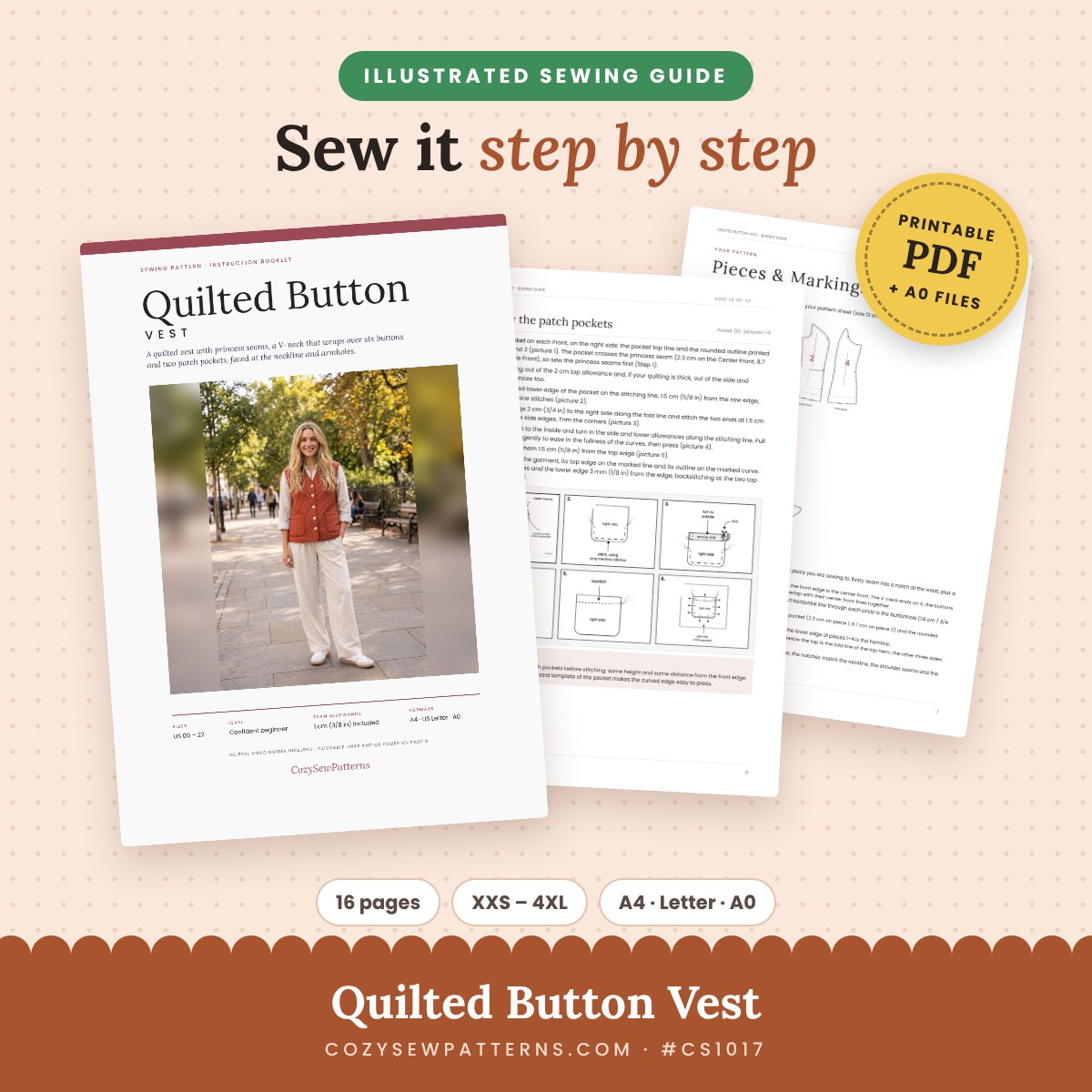
Stuck on a step? Sew it with pictures.
The full illustrated guide for the Quilted Button Vest shows every step in clear drawings, from the princess seams and patch pockets to the V-neck facing and the buttonholes.
- A diagram for every step, 16 pages
- Size charts, finished measurements and fabric amounts
- Tips for sewing quilted fabric + video guides with QR codes
- A0 + Step-by-step guide · instant PDF download
Español · Italiano · Deutsch · Français · Nederlands…
Buy the guide, then email us your language. Free, delivered in 48–72h.
♥ Every guide you buy keeps our patterns free.
Tips and common mistakes
- Bulky seams: trim the batting out of each seam allowance close to the stitching, so the seams lie flat.
- Layers shifting: hold the layers with clips instead of pins, and use a walking foot with a 3–3.5 mm stitch.
- Puckered V-neck point: pin and baste the facing first, check that it lies flat, then stitch.
- Lost markings: quilted fabric does not take tracing wheels well; mark on the right side with tailor’s chalk.
- Buttonhole trouble: test one through all the layers of the front edge on a scrap before sewing the vest.
How to style it
- Relaxed: over a linen shirt with rolled sleeves and our free Barrel Leg Pants.
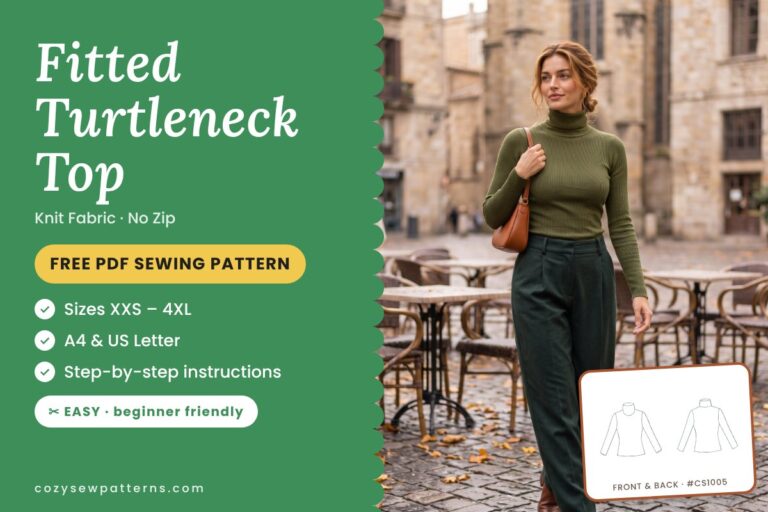
- Everyday: over a long-sleeve tee or our Fitted Turtleneck Top with straight jeans.
- Autumn: over a knit dress or the Bishop Sleeve Blouse, with ankle boots.
- Simple version: sew it in a plain quilted cotton for a vest you will wear all week.
Care
Machine-wash cold on a gentle cycle, inside out with the buttons done up, then dry flat. Skip the tumble dryer, which can shrink the batting and pucker the quilting. Press lightly with steam through a pressing cloth.
Questions
Is the pattern really free?
Yes. The A4 and US Letter pattern files are free. The illustrated step-by-step guide and the A0 file are available for a small coffee.
Is it suitable for beginners?
Yes, for confident beginners. There is no lining, no collar and no sleeves to set in. The new skills (princess seams, facings and buttonholes) are all explained step by step, and quilted fabric is stable and forgiving to sew.
Can I use an old quilt?
Yes. A thin old quilt or patchwork throw makes a lovely upcycled vest. Check it is not too thick (about 5 mm is ideal) and cut the facings from plain cotton if it is.
What seam allowance is included?
1 cm (3/8″) on all seams and 4 cm (1 5/8″) at the hem. The patch pockets have 1.5 cm (5/8″) on the sides and bottom and 2 cm (3/4″) at the top. All are included in the pattern.
Which size should I choose?
Choose from your body measurements, not your ready-to-wear size. Go one size up for a thick quilting or to wear the vest over a warm sweater.
Is the vest lined?
No. The quilted fabric gives it warmth and body, and the neckline and armholes are finished with facings. For a neat inside, bind the seams with bias binding.
What should I sew next?
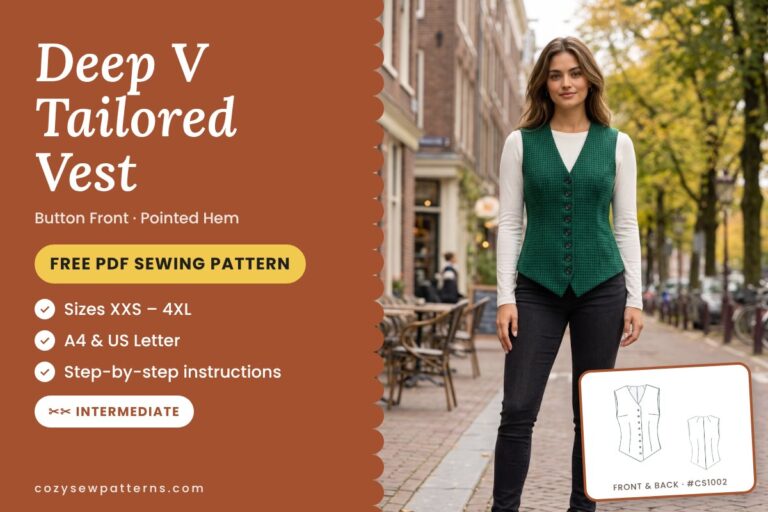
For the full cosy look, try our Quilted Patchwork Jacket #CS1016, sewn in the same kind of fabric. For a tailored, unquilted vest, see our Deep V Tailored Vest #CS1002.
Happy sewing!