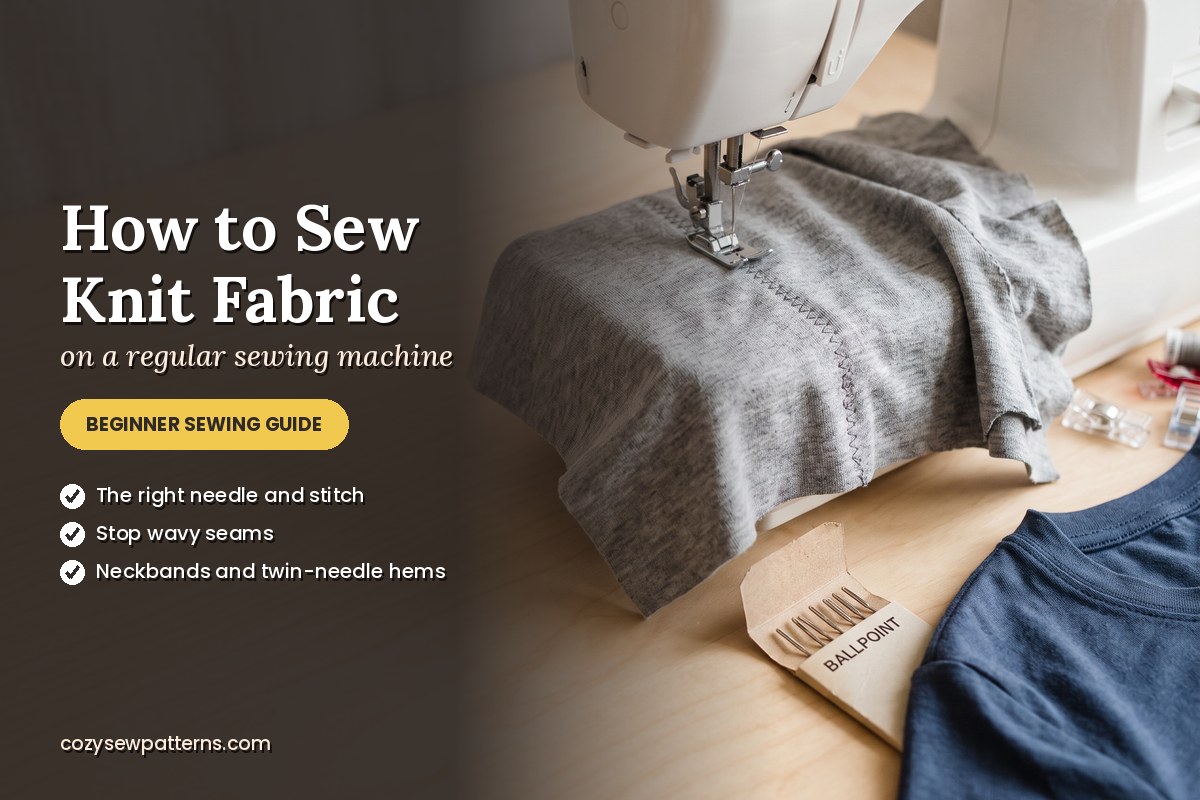
T-shirts, turtlenecks and sweatshirts are some of the most-worn clothes in our wardrobes, and they are all made from knit fabric. Many beginners think they need a serger to sew them. You don’t: a regular sewing machine sews knits beautifully with the right needle, the right stitch and a few simple habits.
Knit vs woven fabric
Woven fabric is made of threads crossing over and under each other, so it barely stretches. Knit fabric is made of interlocking loops, like a hand-knitted jumper in miniature, so it stretches and recovers. That stretch is why knits are comfortable, and also why a normal straight stitch can snap when the seam is pulled.
Easiest knits to start with: ponte, French terry, sweatshirt fleece and thick cotton-elastane jersey. They are stable and do not curl much. Leave thin viscose jersey and slinky knits for later.
Check the stretch
Patterns for knits tell you how much stretch the fabric needs. To check yours, fold the fabric along the crosswise direction, mark 10 cm (4″), and gently stretch it against a ruler:
| 10 cm stretches to… | Stretch | Typical fabrics |
|---|---|---|
| 12–13 cm | 20–30% (low) | Ponte, scuba, sweatshirt fleece |
| 14–15 cm | 40–50% (medium) | French terry, cotton jersey |
| 16 cm or more | 60%+ (high) | Rib knit, jersey with elastane |
Needle and thread
- Ballpoint (jersey) needle 75/11 or 80/12 for most knits. Its rounded tip slips between the loops instead of piercing them, so no holes or ladders.
- Stretch needle 75/11 if your fabric has a lot of elastane and the machine skips stitches.
- Polyester thread: it has a little give, unlike cotton thread.
The best stitches for knits on a regular machine
| Stitch | Settings | Use it for |
|---|---|---|
| Narrow zigzag | Width 0.5–1.5 mm, length 2.5–3 mm | All main seams; the easiest to unpick |
| Lightning bolt / stretch stitch | Machine preset | Seams that will be stretched, like side seams |
| Wide zigzag | Width 4–5 mm, length 2.5 mm | Finishing seam allowances together |
| Twin needle straight stitch | Length 3–3.5 mm | Hems and topstitching that look professional |
| Triple stretch stitch | Machine preset | Very strong seams (hard to unpick!) |
How to avoid wavy, stretched seams
The number one knit problem is a seam that comes out rippled like a lettuce leaf. It happens when the fabric gets stretched as it goes under the foot.
- Never pull or push the fabric. Let the machine feed it and just guide it.
- Reduce the presser-foot pressure if your machine allows it, or use a walking foot.
- Lengthen the stitch a little (2.8–3 mm).
- Support the fabric so it does not hang off the table and drag.
- Starting a seam: hold both thread tails behind the foot for the first few stitches, or start on a small scrap of fabric, so the machine does not swallow the edge.
- Already wavy? Press it with plenty of steam: most knits shrink back flat.
Stabilising shoulders
Shoulder seams carry the weight of the whole garment and stretch out over time. Sew a strip of clear elastic, twill tape or a narrow strip of fusible stay tape into the shoulder seams to keep them stable.
Neckbands, cuffs and ribbing
- Bands are cut shorter than the opening they go into, usually 75–90% of its length, and stretched to fit as you sew. That is what makes them lie flat.
- Divide both the band and the opening into quarters with pins, then match the pins. Stretch only the band, not the garment.
- Sew with the band on top so you can see and control the stretch.
Hemming knits without a serger
- Twin needle: two parallel straight lines on top, a zigzag underneath. It stretches and looks just like a shop-bought hem. Use a twin stretch needle and sew from the right side.
- Stabilise the hem with a narrow strip of fusible web or knit stay tape so the twin needle does not tunnel.
- Zigzag hem: a simple wide zigzag is the easiest option for casual wear.
- No hem at all: many knits do not fray, so a raw cut edge or a band (like a sweatshirt) is perfectly fine.
Free knit patterns to try
Ready to sew stretch fabric? These free patterns are made for knits and come in sizes XXS–4XL, with A4 and US Letter files.
The Fitted Turtleneck Top has only 4 pieces: a great first knit project.
Frequently asked questions
Can I sew knit fabric without a serger?
Yes. Use a ballpoint needle, polyester thread and a narrow zigzag or stretch stitch on your regular sewing machine, and hem with a twin needle or a zigzag.
What stitch should I use for stretch fabric?
A narrow zigzag (0.5–1.5 mm wide, 2.5–3 mm long) works for most seams. A lightning bolt stretch stitch is stronger for seams that will be pulled a lot.
Why are my knit seams wavy?
The fabric is being stretched as it is sewn. Do not pull it, reduce the presser-foot pressure or use a walking foot, lengthen the stitch slightly and steam the seam to shrink it back.
What needle do I use for knit fabric?
A ballpoint or jersey needle in size 75/11 or 80/12. Use a stretch needle for fabrics with a lot of elastane if stitches are skipped.
Happy sewing!