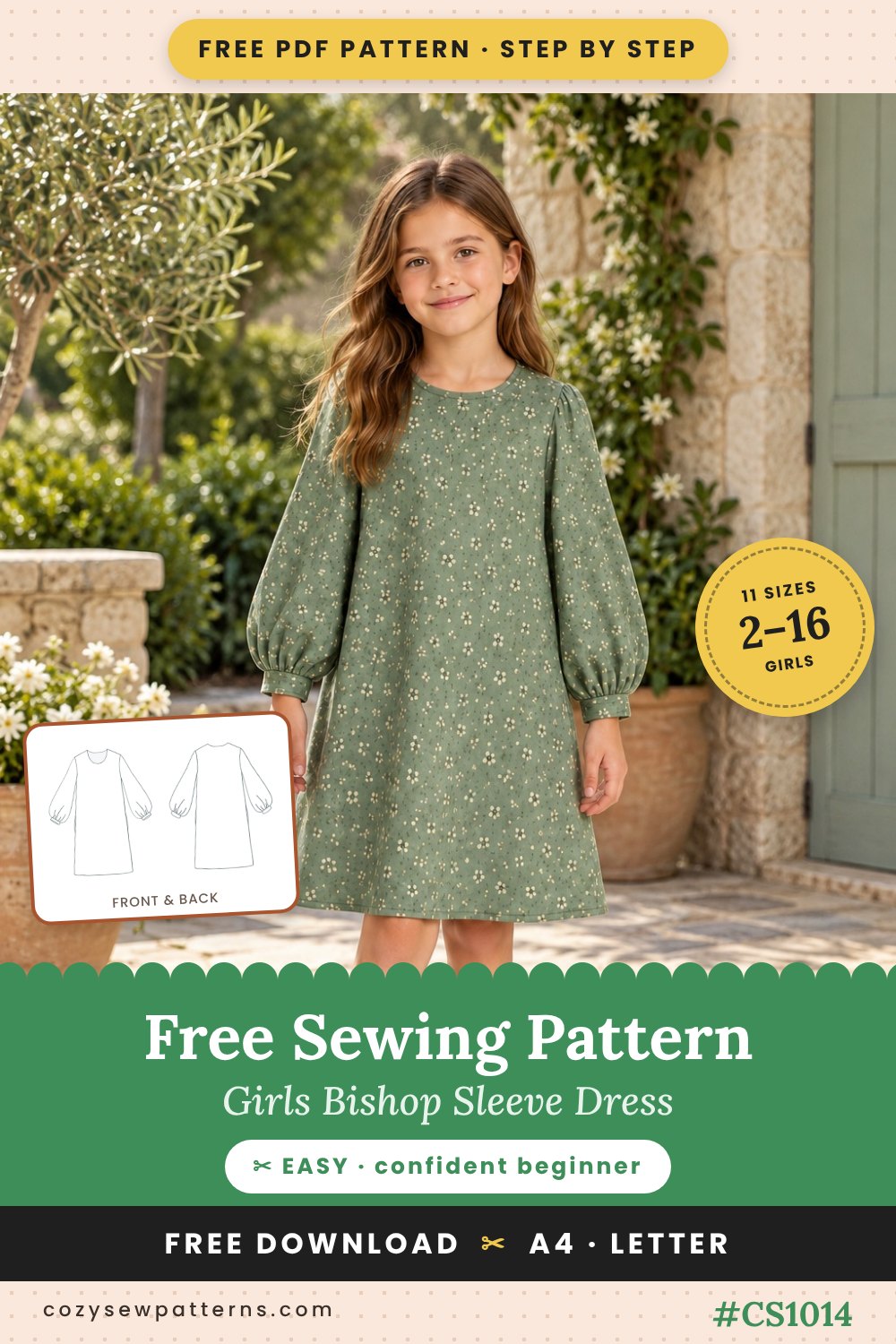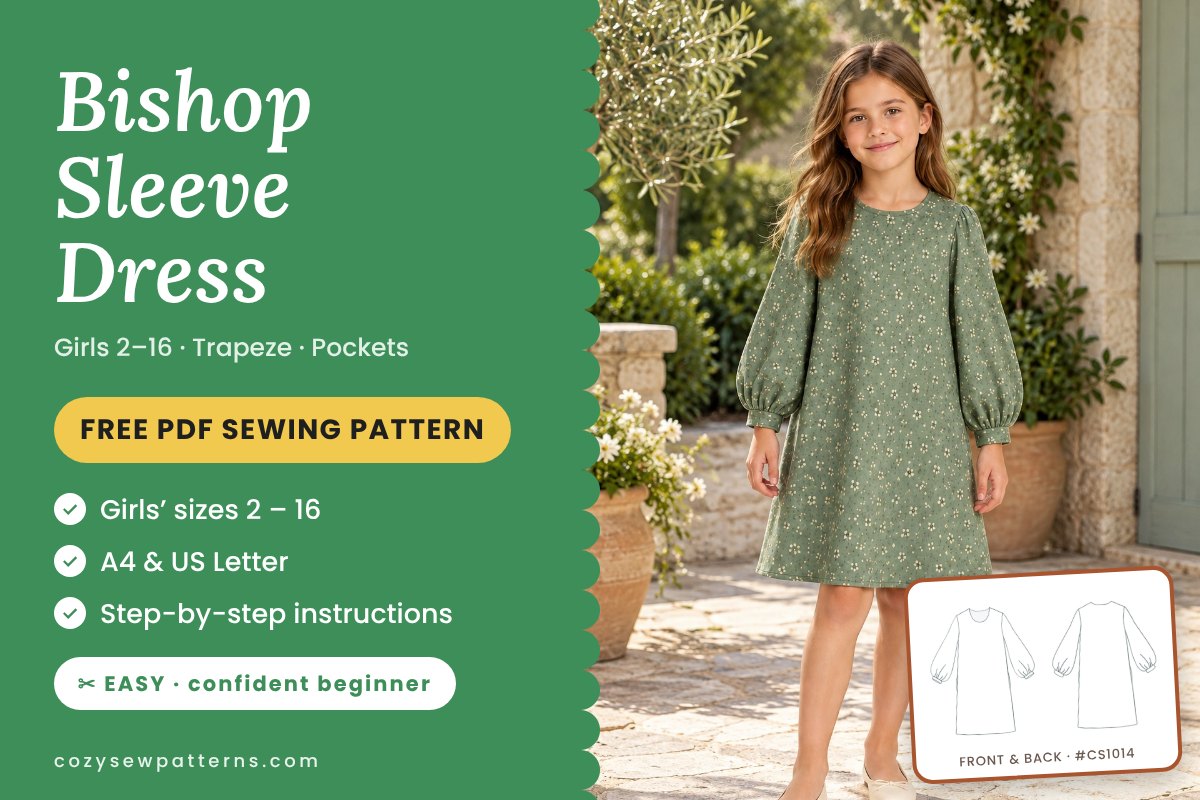
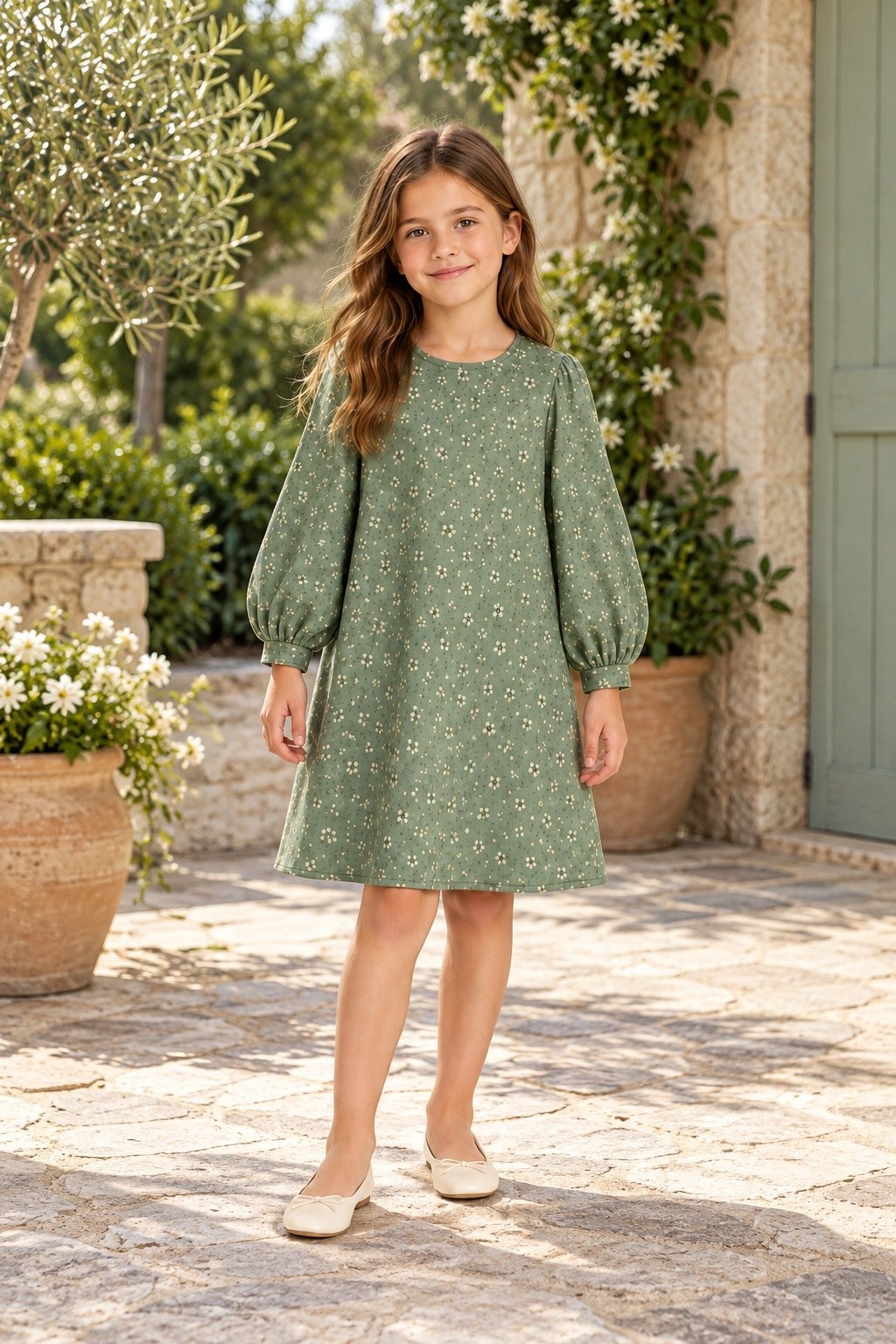
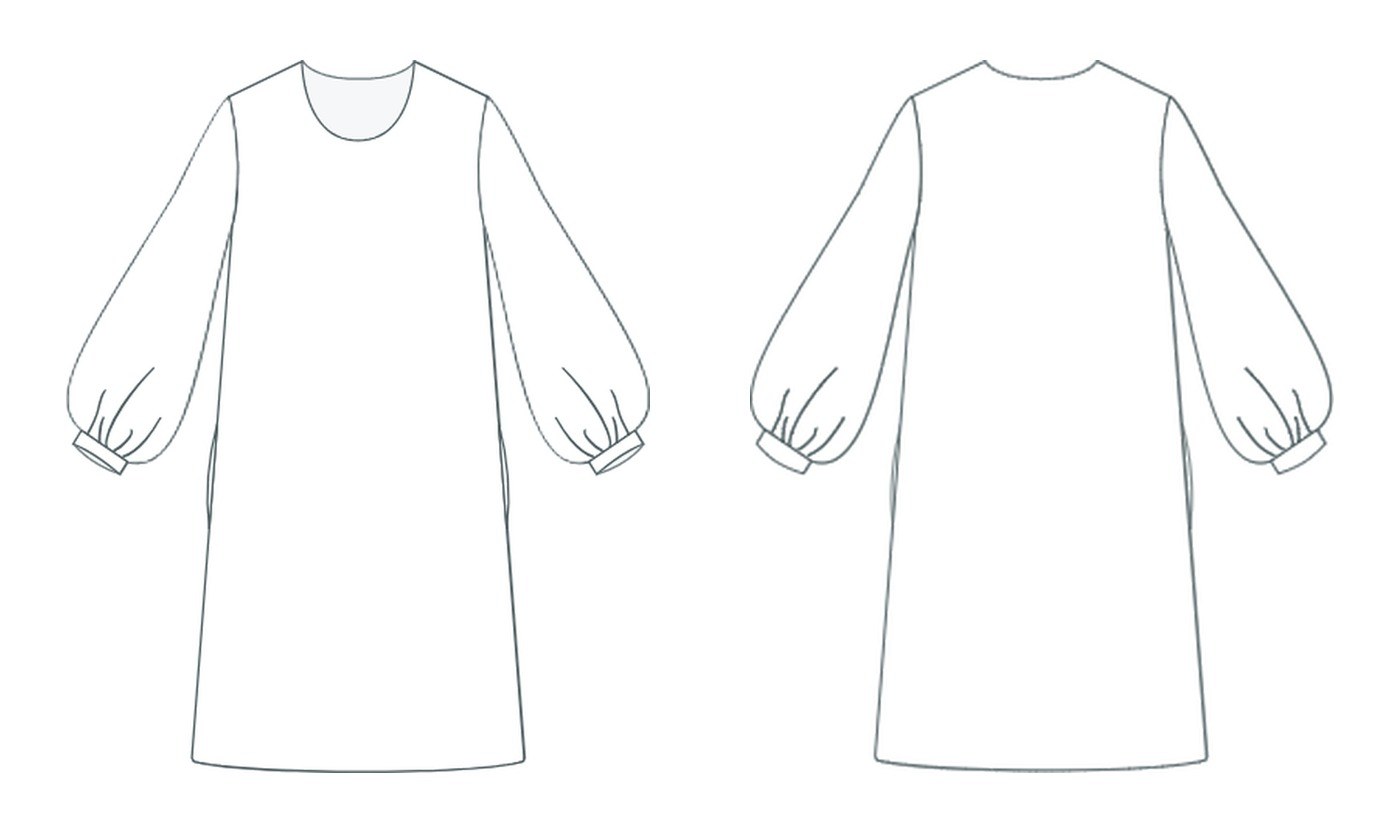
A swingy trapeze dress for girls with full bishop sleeves gathered into narrow cuffs. The Front and Back are each cut in one piece from the shoulders to just above the knee, with no waist seam, so it is quick to sew and lovely to twirl in. The round neckline is finished inside with a bias facing, two in-seam pockets hide in the side seams, and a short back opening with a loop and a button lets the dress slip on easily.
Download the free PDF sewing pattern in A4 and US Letter, in 11 girls’ sizes from 2 to 16 (both size groups in one download), and sew your own long sleeve girls’ dress!
Materials
- Main fabric: 0.7–1.9 m (7/8–2 1/8 yd) of 150 cm (60″) wide fabric, or 1.0–2.3 m (1 1/8–2 5/8 yd) of 115 cm (45″) wide fabric, depending on the size (table below). Choose a light to medium-weight woven with a soft drape, so the sleeves gather nicely: cotton poplin, cotton lawn, double gauze, viscose (rayon) challis, light cotton flannel, cotton-linen or fine babycord
- Pocket bags: 0.3–0.4 m (3/8–1/2 yd) of cotton lining, a lightweight cotton or the main fabric
- Lightweight fusible interfacing: 10 cm (1/8 yd), 90 cm (36″) wide, for the cuffs
- 1 flat button, 10–12 mm (3/8–1/2″), and 8 cm (3″) of thin round elastic cord for the loop
- Matching all-purpose thread, a hand-sewing needle, chalk or a washable pen and a point turner
Small prints like the one in the photo are perfect. Avoid stiff fabrics such as canvas or denim, and knits. Pre-wash cotton and linen the way you will wash the dress, since they can shrink 3–5%. Add 10–15% for a one-way print or a fabric that needs matching.
Pattern pieces
- Front, main fabric: cut 1 (single layer, whole piece)
- Back, main fabric: cut 1 (single layer, whole piece)
- Sleeve, main fabric: cut 2 (mirror pair)
- Cuff, main fabric + interfacing: cut 2 + 2
- Pocket Bag, lining or main fabric: cut 4 (2 mirror pairs)
- Neck bias strip (no pattern piece): 1 strip 4 cm (1 5/8″) wide, cut on the bias (length in the table below)
- Back slit facing (no pattern piece): 6 × 12 cm (2 3/8 × 4 3/4″) for sizes 2–6, 6 × 13 cm (2 3/8 × 5 1/8″) for sizes 7–16
The Front and Back are printed as whole pieces: cut them on a single layer, right side up, not on a fold. Transfer the centre lines, the armhole notches (one on the front, two on the back), the pocket notches, the sleeve dots and, for sizes 7–16, the two small back shoulder darts. Fuse the interfacing to the cuffs before you start sewing.
Download the free PDF sewing pattern
One file per size, in the paper format that suits you. Share your finished dress with #cozysewpatterns!
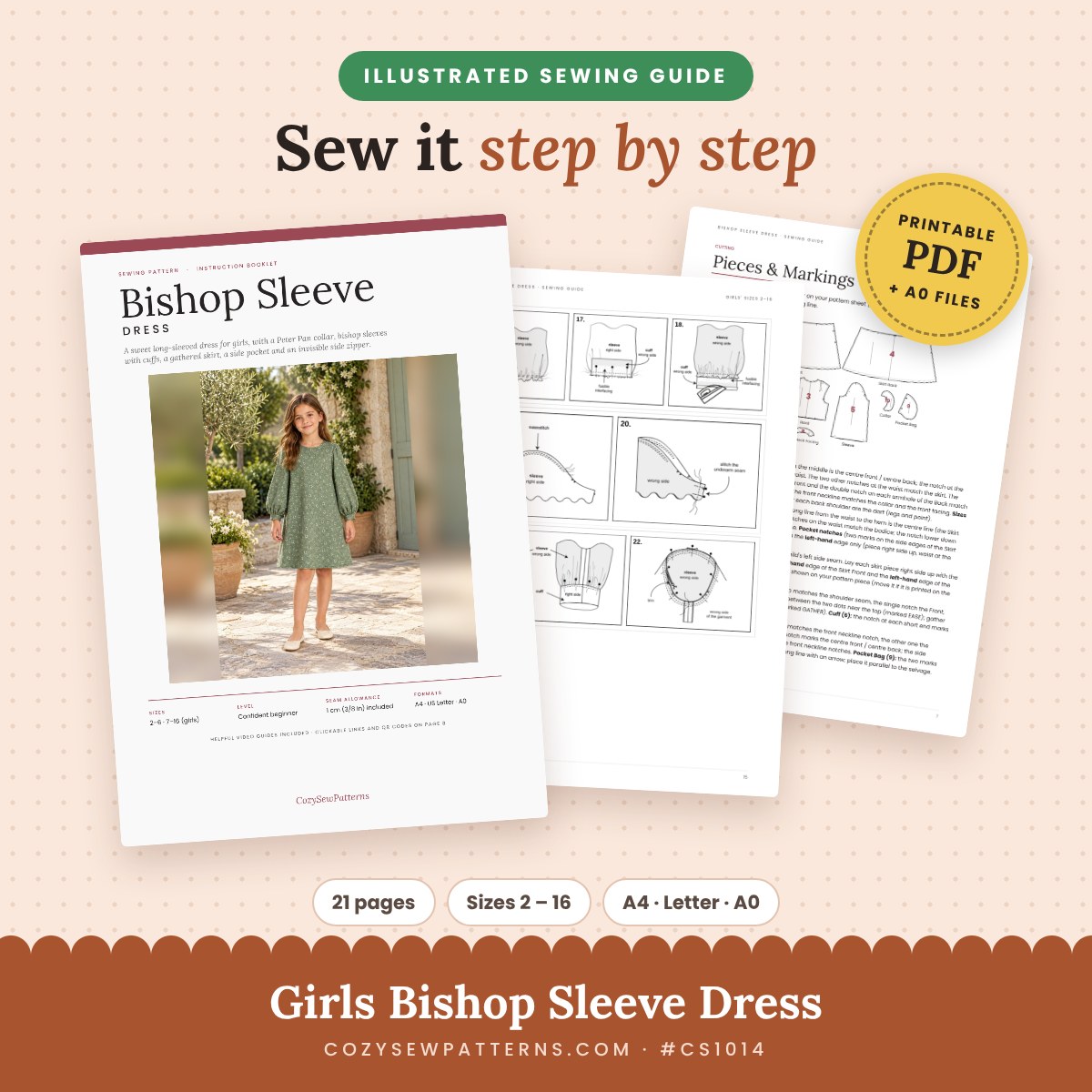 A0 + Step-by-step guideGet it here ↓
Unzip the folder first. Print page 1 at 100% (actual size) and measure the 10 cm (4″) calibration square before printing the rest. Trim the margins and tape the pages together, matching the markers. The A0 file comes with the illustrated guide below.
Sizing guide
Girls’ sizes 2–6 and 7–16, for heights from 91 to 164 cm (36–64 1/2″); the dress ends just above the knee. Choose the size by chest measurement and check the length against the height. The dress has about 5 cm (2″) of ease at the chest and flares out from there, so between two sizes choose the larger one: there is room to grow.
Both size groups are sewn the same way. The only difference: the Back of sizes 7–16 has two small shoulder darts for a better fit over the shoulder blades. To change the length, add or remove the same amount at the lower edge of the Front and Back.
Body measurements (cm)
| cm | 2 | 3 | 4 | 5 | 6 | 7 | 8 | 10 | 12 | 14 | 16 |
|---|---|---|---|---|---|---|---|---|---|---|---|
| Height | 91.4 | 99.1 | 106.7 | 114.3 | 120.7 | 127 | 132 | 144.8 | 157.8 | 162 | 163.8 |
| Chest | 53.3 | 54.6 | 56.5 | 58.4 | 60.3 | 58.5 | 63.8 | 70 | 75 | 78.8 | 82.8 |
| Waist | 48.9 | 50.5 | 52.1 | 54 | 55.9 | 52.8 | 56 | 59.2 | 62.2 | 64 | 66.2 |
| Hips | 52.7 | 54.6 | 57.5 | 60.3 | 63.2 | 62.8 | 67.5 | 75 | 80.2 | 85 | 90.2 |
Body measurements (inches)
| in | 2 | 3 | 4 | 5 | 6 | 7 | 8 | 10 | 12 | 14 | 16 |
|---|---|---|---|---|---|---|---|---|---|---|---|
| Height | 36 | 39 | 42 | 45 | 47 1/2 | 50 | 52 | 57 | 62 1/8 | 63 3/4 | 64 1/2 |
| Chest | 21 | 21 1/2 | 22 1/4 | 23 | 23 3/4 | 23 | 25 1/8 | 27 1/2 | 29 1/2 | 31 | 32 5/8 |
| Waist | 19 1/4 | 19 7/8 | 20 1/2 | 21 1/4 | 22 | 20 3/4 | 22 | 23 3/8 | 24 1/2 | 25 1/4 | 26 1/8 |
| Hips | 20 3/4 | 21 1/2 | 22 5/8 | 23 3/4 | 24 7/8 | 24 3/4 | 26 5/8 | 29 1/2 | 31 5/8 | 33 1/2 | 35 1/2 |
Finished garment measurements (cm)
| cm | 2 | 3 | 4 | 5 | 6 | 7 | 8 | 10 | 12 | 14 | 16 |
|---|---|---|---|---|---|---|---|---|---|---|---|
| Chest | 58.3 | 59.6 | 61.5 | 63.4 | 65.3 | 63.5 | 68.8 | 75 | 80 | 83.8 | 87.8 |
| Hips | 65.8 | 68.3 | 71.8 | 75.2 | 78.6 | 72.8 | 78.2 | 86.9 | 93 | 98.5 | 104.5 |
| Hem width | 73.4 | 77.3 | 82.9 | 88.1 | 93.8 | 84 | 90.1 | 101.5 | 108.7 | 115.3 | 123.3 |
| Back length | 52.5 | 57.3 | 62.1 | 66.9 | 70.9 | 74.9 | 78.1 | 86.1 | 94.3 | 97 | 98.1 |
| Sleeve | 36.7 | 39.5 | 42.2 | 45 | 47.3 | 49.5 | 51.3 | 55.9 | 60.7 | 62.2 | 62.9 |
Fabric per size
| 2 | 3 | 4 | 5 | 6 | 7 | 8 | 10 | 12 | 14 | 16 | |
|---|---|---|---|---|---|---|---|---|---|---|---|
| 150 cm wide (m) | 0.7 | 0.8 | 0.9 | 0.9 | 1 | 1 | 1.1 | 1.4 | 1.6 | 1.9 | 1.9 |
| 60″ wide (yd) | 7/8 | 7/8 | 1 | 1 | 1 1/8 | 1 1/8 | 1 1/4 | 1 5/8 | 1 3/4 | 2 1/8 | 2 1/8 |
| 115 cm wide (m) | 1 | 1.1 | 1.3 | 1.3 | 1.4 | 1.5 | 1.5 | 1.7 | 2 | 2 | 2.3 |
| 45″ wide (yd) | 1 1/8 | 1 1/4 | 1 1/2 | 1 1/2 | 1 5/8 | 1 3/4 | 1 3/4 | 1 7/8 | 2 1/4 | 2 1/4 | 2 5/8 |
| Pocket bags 115 cm (m) | 0.3 | 0.3 | 0.3 | 0.3 | 0.3 | 0.3 | 0.3 | 0.3 | 0.4 | 0.4 | 0.4 |
| Bias strip length (cm) | 42 | 43 | 45 | 46 | 47 | 46 | 48 | 49 | 51 | 52 | 53 |
Sewing notes
Fit and style
An easy trapeze dress with about 5 cm of ease at the chest, flaring gently to the hem, with no waist seam to fit. The full bishop sleeves are gathered into 2.5 cm (1″) cuffs, which keeps them out of the way for play. Over tights and a cardigan it works all autumn and winter; in a light lawn it is a pretty spring dress.
Fabrics
Soft drapey wovens let the sleeves gather beautifully: cotton poplin and lawn for every day, double gauze for a cosy feel, viscose challis for movement, or light flannel and fine babycord for winter. A small floral or ditsy print, like in the photo, suits the shape perfectly.
Cutting out
Cut the Front and Back on a single layer, then fold the fabric right sides together for the Sleeves and Pocket Bags. Draw the bias strip at 45° to the selvage, 4 cm (1 5/8″) wide; if it is too short, join two strips on the straight grain. Try the back slit facing once on two scraps before sewing the real one.
Step-by-Step Sewing Instructions
Seam allowances are 1 cm (3/8″). Sew with right sides together, finish the raw edges and press every seam as you go.
- Sew the back shoulder darts (sizes 7–16 only).
- Make the back neck opening with the slit facing.
- Sew the shoulder seams.
- Finish the neckline with the bias facing, catching the loop, and sew on the button.
- Attach the pocket bags.
- Sew the side seams around the pockets.
- Gather the sleeves and attach the cuffs.
- Sew the underarm seams and close the cuffs.
- Set in the sleeves.
- Hem the dress.
- Finish with a final press, keeping the sleeve gathers soft.
Stuck on a step? Sew it with pictures.
The steps above are a quick overview. The full illustrated guide walks you through every step with clear drawings: the back neck slit with its facing (the trickiest step), the bias-faced neckline with loop and button, the in-seam pockets and the gathered bishop sleeves with cuffs. It also includes the A0 pattern file.
- Illustrated diagrams for every step
- Before-you-begin checklist
- Bias strip length for every size
- Video guides with QR codes for the key techniques
- A0 pattern file included
- Printable PDF, instant download
Español · Italiano · Deutsch · Français · Nederlands…
Buy the guide, then email us your language. Free, delivered in 48–72h.
♥ Every guide you buy keeps our patterns free.
Questions
Is the pattern really free?
Yes. The A4 and US Letter pattern files are free. The illustrated step-by-step guide and the A0 file are available for a small coffee.
Is it suitable for beginners?
Yes, for confident beginners. There is no waist seam and no zipper. The new skills are a small faced slit at the back neck, a bias-faced neckline and gathered sleeves with cuffs, all explained step by step.
Which size should I sew?
Measure the child’s chest and choose the size from the chart, then check the length against the height and the finished back length. Between two sizes, take the larger one: there is room to grow.
Can we sew matching outfits?
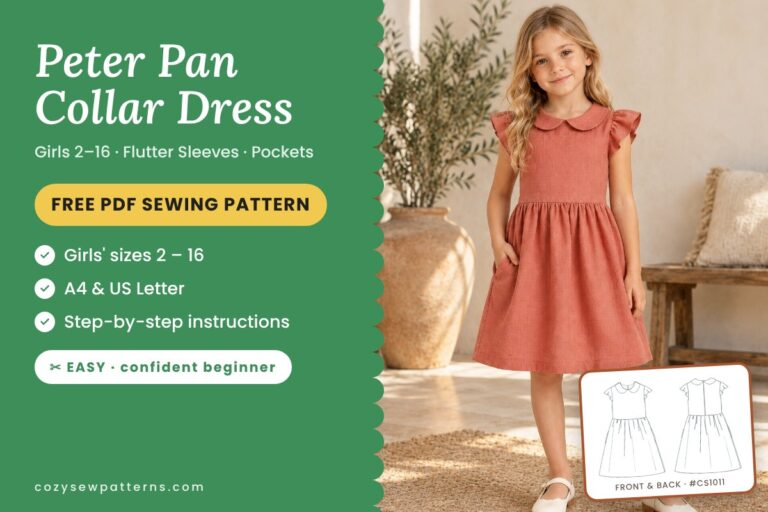
Yes! For a mother-and-daughter look, our women’s Bishop Sleeve Blouse #CS1004 has the same full sleeves. For another girls dress, try the Peter Pan Collar Dress #CS1011.
Happy sewing!