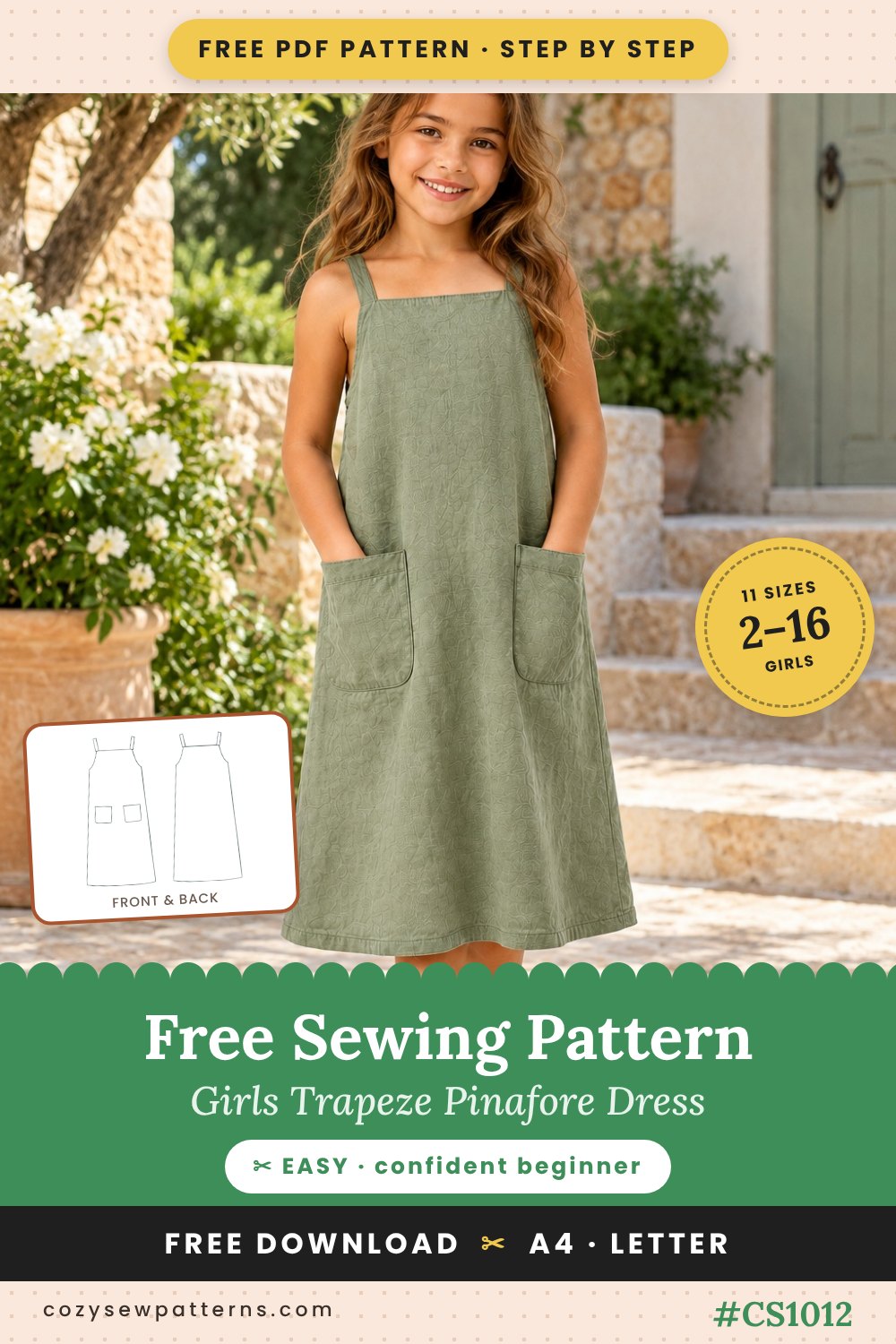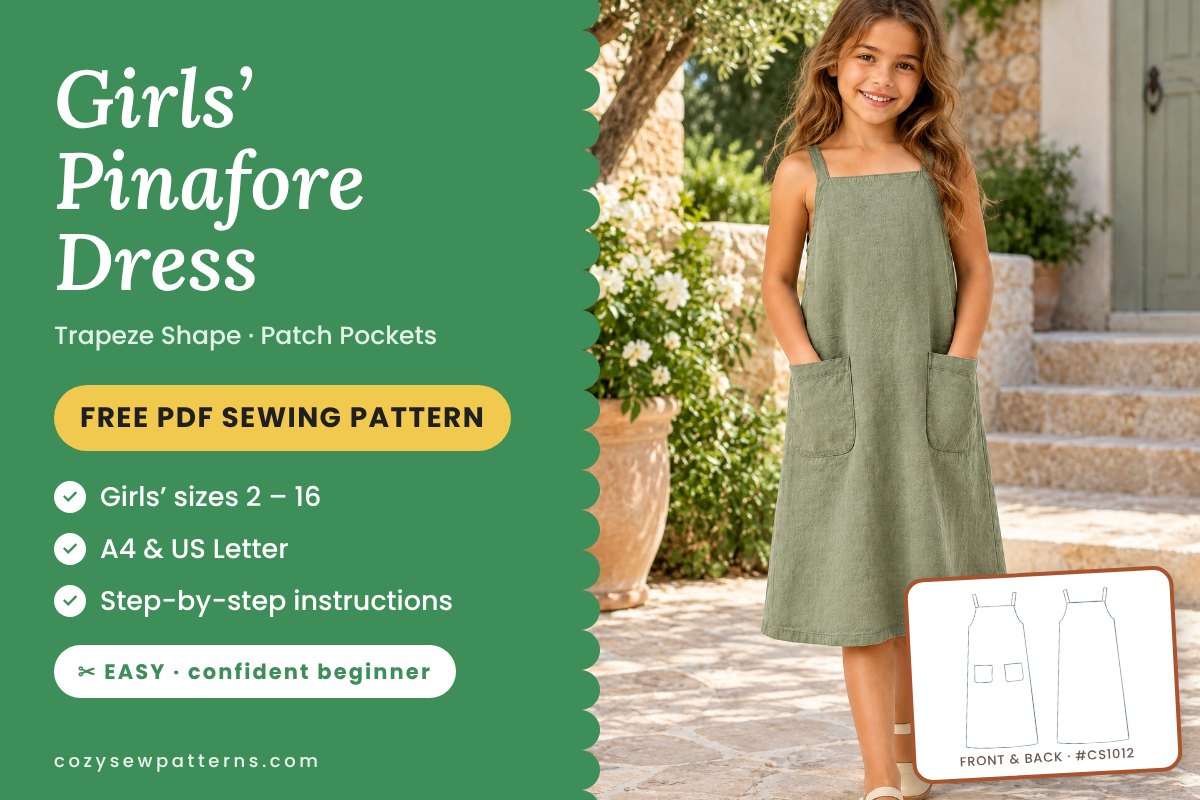
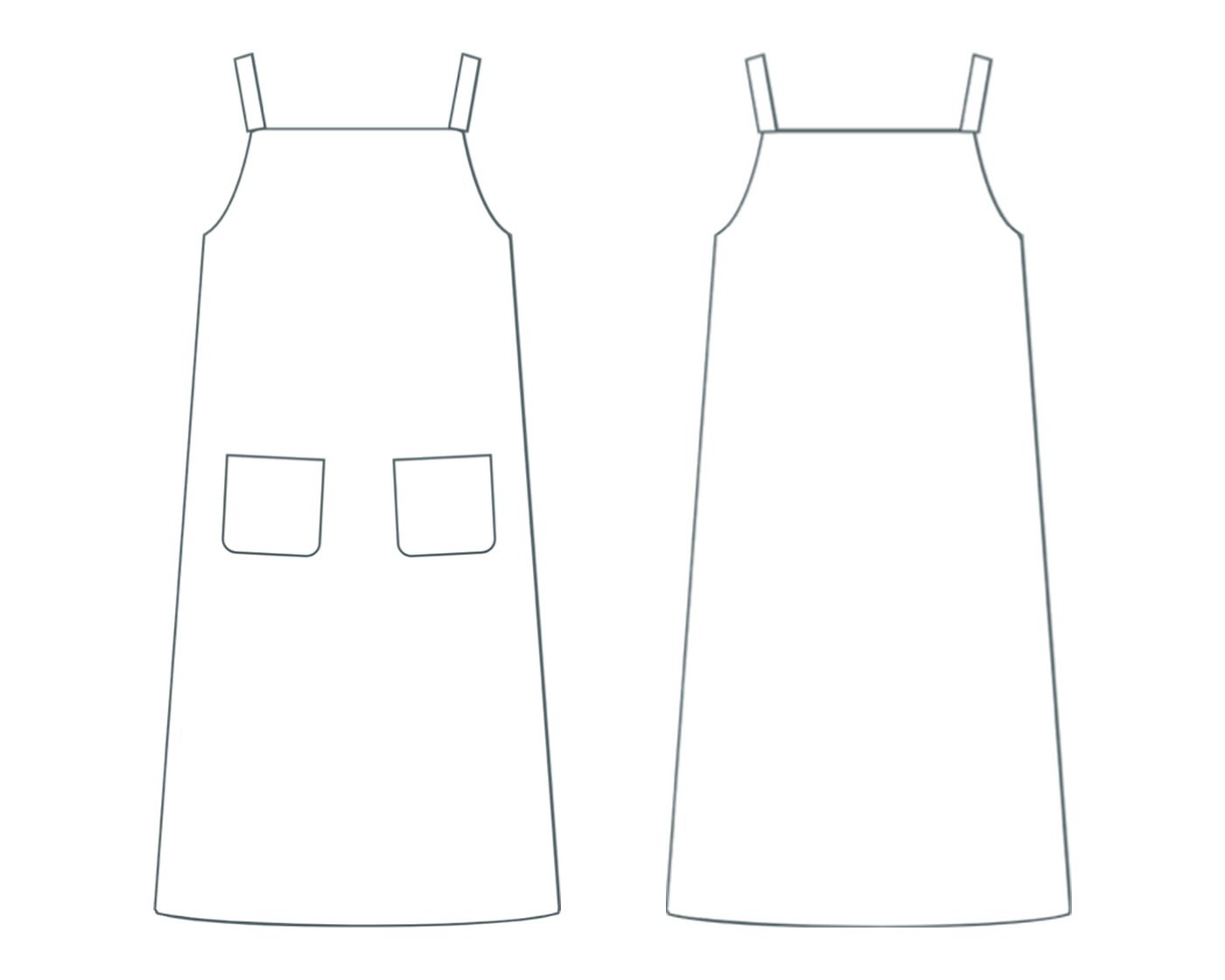
An easy trapeze pinafore for girls that layers over tees, blouses and fine knits all year round. It has a straight neckline front and back, slim turned straps, two roomy patch pockets with rounded corners and a flared skirt that falls just below the knee. There are no buttons and no zipper: it simply slips on over the head, so little ones can dress themselves, and the neckline and armholes are finished neatly inside with facings.
Download the free PDF sewing pattern in A4 and US Letter, in 11 girls’ sizes from 2 to 16 (both size groups in one download), and sew your own girls’ pinafore dress!
Materials
- Main fabric: 0.6–1.2 m (3/4–1 3/8 yd) of 150 cm (60″) wide fabric, or 0.6–2.1 m (3/4–2 3/8 yd) of 115 cm (45″) wide fabric, depending on the size (table below). Choose a medium-weight, non-stretch woven with a little body: cotton twill, chambray, light denim, linen or cotton-linen, textured cotton (jacquard, dobby, waffle), babycord, seersucker or gingham
- Lightweight fusible interfacing: 0.3 m (3/8 yd), 90 cm (36″) wide, for the two facings and the straps
- Matching all-purpose thread
- A loop turner, bodkin or small safety pin for turning the straps
- Chalk or a washable marker, pins or clips, and tracing paper for the facings
- Optional: a lighter cotton (lawn or poplin) in a matching colour for the facings, to reduce bulk with thicker fabrics
Very soft or slippery fabrics such as viscose or satin are not recommended: the trapeze shape and the slim straps need a fabric that holds its shape. Pre-wash cotton and linen the way you will wash the pinafore, since they can shrink 3–5%. For checks, stripes or a one-way print, add 15–20% fabric.
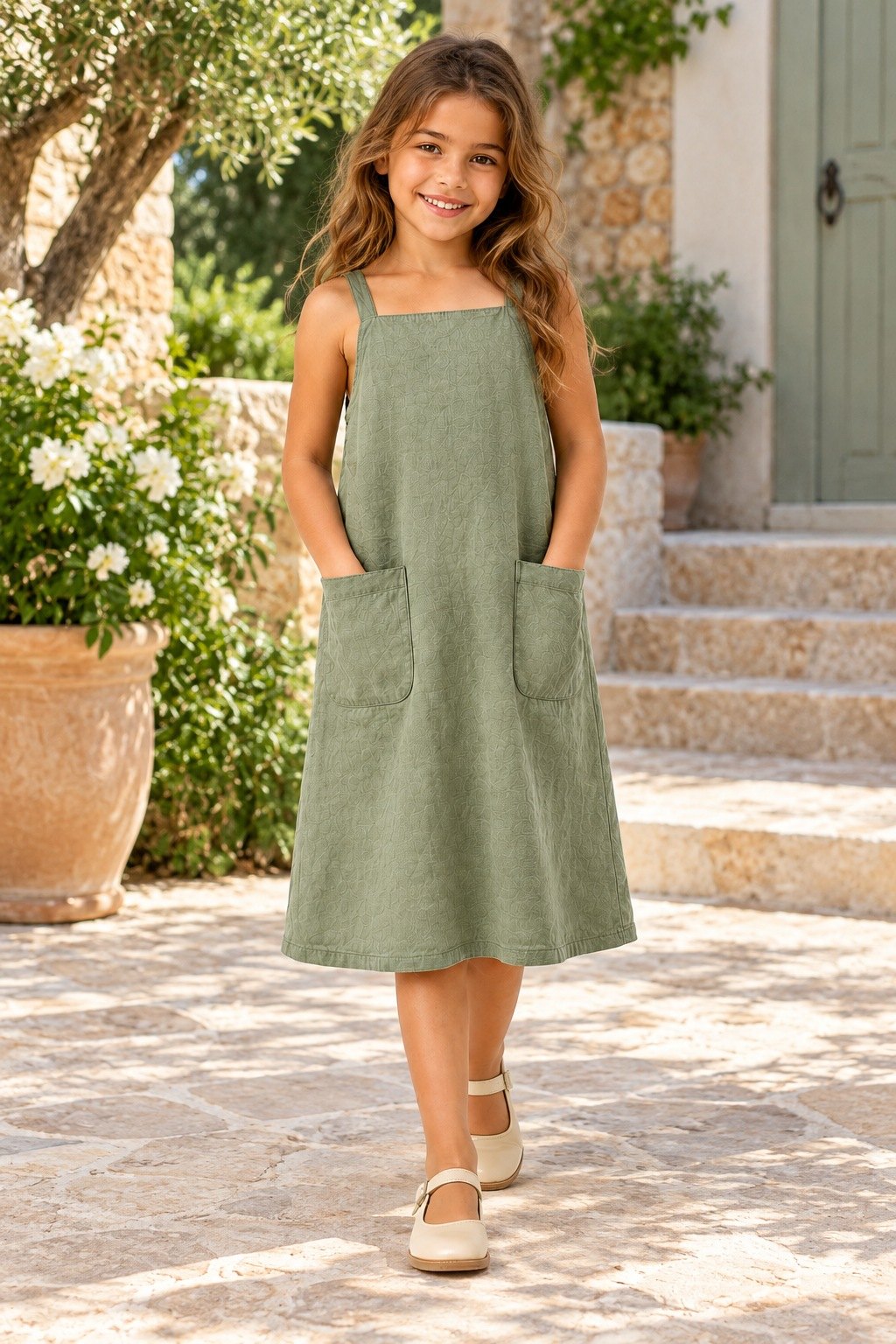
Pattern pieces
- Front, main fabric: cut 1 (full piece, not on the fold; pocket placement marked)
- Back, main fabric: cut 1 (full piece, not on the fold)
- Strap, main fabric + interfacing: cut 2 + 2
- Patch Pocket, main fabric: cut 2
- Front facing A (traced from the Front), main fabric + interfacing: cut 1 + 1
- Back facing B (traced from the Back), main fabric + interfacing: cut 1 + 1
The facings have no pattern piece: trace them from the top of the Front and Back, about 5 cm (2″) deep below the stitching line, following the neckline and armhole curves. Cut everything in a single layer, right side up, and cut the straps on the straight grain so they do not stretch. Transfer the strap notches, the armhole notches (one on the Front, two on the Back), the side notches and the pocket placement.
Download the free PDF sewing pattern
One file per size, in the paper format that suits you. Share your finished pinafore with #cozysewpatterns!
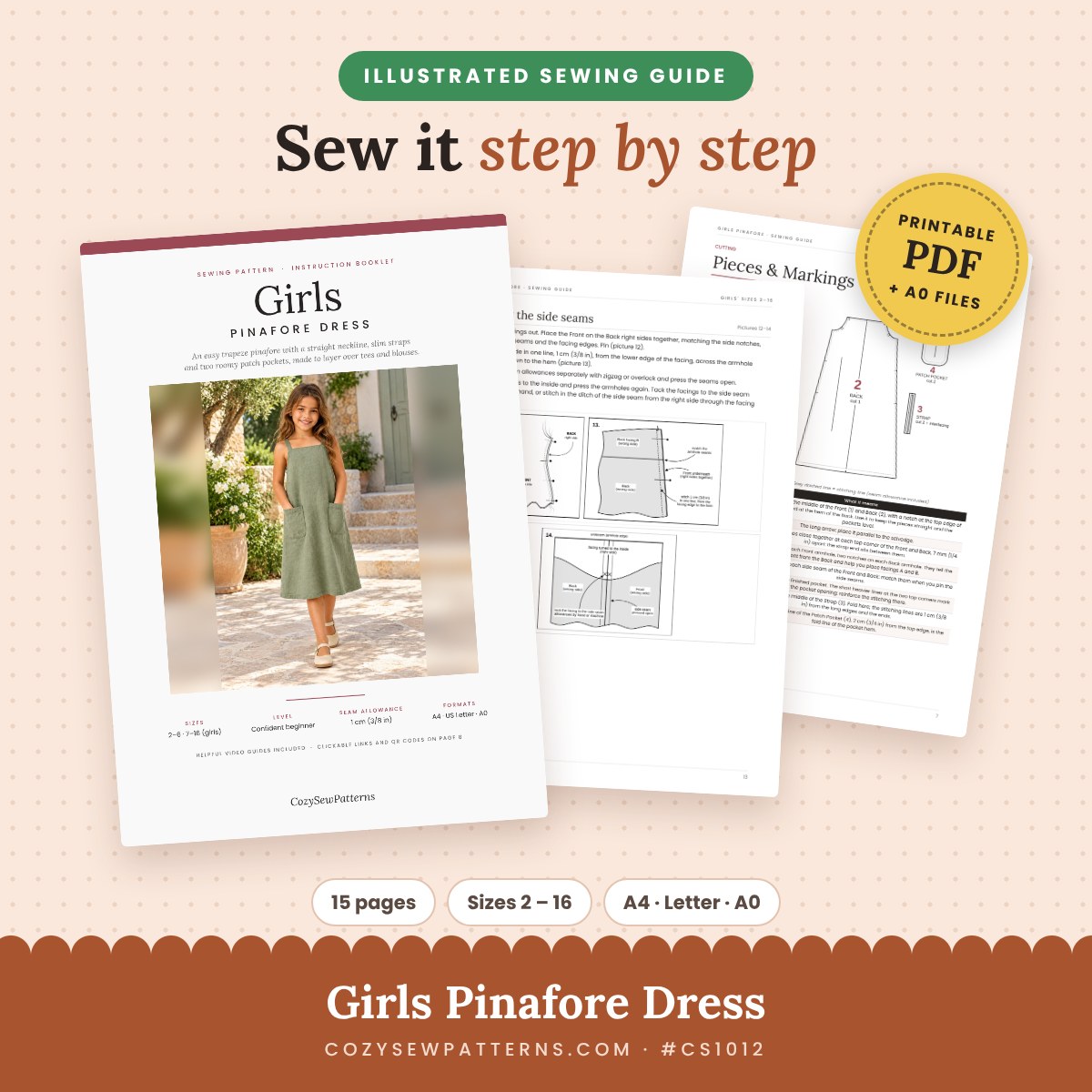 A0 + Step-by-step guideGet it here ↓
Unzip the folder first. Print page 1 at 100% (actual size) and measure the 10 cm (4″) calibration square before printing the rest. Trim the margins and tape the pages together, matching the markers. The A0 file comes with the illustrated guide below.
Design details and fit
An easy trapeze pinafore for girls that slips on over the head, made to layer over tees and blouses. Here is what makes it:
- Shape: woven trapeze pinafore with no waist seam
- Neckline: straight (square) neckline on the front and back
- Straps: slim turned straps, 7 mm (1/4″) wide, sewn into the facing seam
- Inside: clean finish with traced facings for the neckline and armholes
- Pockets: two roomy patch pockets with rounded corners
- Length: below the knee with a curved hem; no buttons, no zip
The pinafore is close-fitting at the underarm, then flares out. Both size groups (2–6 and 7–16) use the same four pattern pieces and the same steps.
Sizing guide
Girls’ sizes 2–6 and 7–16, for heights from 91 to 164 cm (36–64 1/2″); the pinafore falls just below the knee. Choose the size by chest measurement. It is close-fitting at the underarm (the finished chest is only about 0.5 cm bigger than the body) and flares out from there, so if the child is between sizes, or will wear it over a sweater, choose the larger size. Check the length against the height and the back length below.
Both size groups use the same four pieces and the same steps. Sizes 7–16 are drafted for a slimmer build, so size 7 is a little narrower at the chest than size 6 but longer. The size number is close to the age, but always go by the measurements.
Body measurements (cm)
| cm | 2 | 3 | 4 | 5 | 6 | 7 | 8 | 10 | 12 | 14 | 16 |
|---|---|---|---|---|---|---|---|---|---|---|---|
| Height | 91.4 | 99.1 | 106.7 | 114.3 | 120.7 | 127 | 132 | 144.75 | 157.75 | 162 | 163.75 |
| Chest | 53.3 | 54.6 | 56.5 | 58.4 | 60.3 | 58.5 | 63.75 | 70 | 75 | 78.75 | 82.75 |
| Waist | 48.9 | 50.5 | 52.1 | 54 | 55.9 | 52.75 | 56 | 59.25 | 62.25 | 64 | 66.25 |
| Hips | 52.7 | 54.6 | 57.5 | 60.3 | 63.2 | 62.75 | 67.5 | 75 | 80.25 | 85 | 90.25 |
Body measurements (inches)
| in | 2 | 3 | 4 | 5 | 6 | 7 | 8 | 10 | 12 | 14 | 16 |
|---|---|---|---|---|---|---|---|---|---|---|---|
| Height | 36 | 39 | 42 | 45 | 47 1/2 | 50 | 52 | 57 | 62 1/8 | 63 3/4 | 64 1/2 |
| Chest | 21 | 21 1/2 | 22 1/4 | 23 | 23 3/4 | 23 | 25 1/8 | 27 1/2 | 29 1/2 | 31 | 32 5/8 |
| Waist | 19 1/4 | 19 7/8 | 20 1/2 | 21 1/4 | 22 | 20 3/4 | 22 | 23 3/8 | 24 1/2 | 25 1/4 | 26 1/8 |
| Hips | 20 3/4 | 21 1/2 | 22 5/8 | 23 3/4 | 24 7/8 | 24 3/4 | 26 5/8 | 29 1/2 | 31 5/8 | 33 1/2 | 35 1/2 |
Finished garment measurements (cm)
| cm | 2 | 3 | 4 | 5 | 6 | 7 | 8 | 10 | 12 | 14 | 16 |
|---|---|---|---|---|---|---|---|---|---|---|---|
| Chest | 54 | 55 | 57 | 59 | 61 | 59 | 64 | 70 | 75 | 78 | 82 |
| Hips | 62 | 65 | 68 | 71 | 74 | 73 | 78 | 87 | 93 | 99 | 104 |
| Hem width | 71 | 75 | 80 | 85 | 90 | 91 | 96 | 108 | 116 | 123 | 130 |
| Back length | 49 | 54 | 58 | 63 | 67 | 71 | 74 | 82 | 89 | 92 | 93 |
| Strap length | 14.3 | 15.3 | 16.3 | 17.5 | 17.9 | 18.4 | 18.7 | 20.3 | 22.1 | 23.4 | 23.8 |
| Pocket (w × h) | 9 × 10 | 9 × 10 | 10 × 11 | 10 × 11 | 10 × 11 | 11 × 12 | 11 × 12 | 11 × 13 | 12 × 14 | 13 × 14 | 13 × 14 |
Fabric per size
| 2 | 3 | 4 | 5 | 6 | 7 | 8 | 10 | 12 | 14 | 16 | |
|---|---|---|---|---|---|---|---|---|---|---|---|
| 150 cm wide (m) | 0.6 | 0.7 | 0.7 | 0.8 | 0.8 | 0.9 | 0.9 | 1 | 1.1 | 1.2 | 1.2 |
| 60″ wide (yd) | 3/4 | 7/8 | 7/8 | 7/8 | 7/8 | 1 | 1 | 1 1/8 | 1 1/4 | 1 3/8 | 1 3/8 |
| 115 cm wide (m) | 0.6 | 0.7 | 0.7 | 0.8 | 1 | 1 | 1 | 1.1 | 1.3 | 2 | 2.1 |
| 45″ wide (yd) | 3/4 | 7/8 | 7/8 | 7/8 | 1 1/8 | 1 1/8 | 1 1/8 | 1 1/4 | 1 1/2 | 2 1/4 | 2 3/8 |
Common fit adjustments
- Choose by the chest: the chest has very little ease, so between two sizes take the larger one.
- Over a sweater: choose the larger size.
- Longer or shorter: change the length at the hem, following the flare of the side seams.
- Thicker fabric: in wide-wale corduroy or quilted fabric, go up one size and cut the facings from a lighter cotton.
Sewing notes
Fit and style
A relaxed trapeze shape with no waist seam: fitted at the underarm, then flaring gently to a curved hem below the knee. To change the length, add or remove the same amount at the hem of the Front and Back, following the flare of the side seams. Over a long-sleeve tee and tights it works all winter; on its own it is a cool summer dress.
Cutting out
Open the fabric out in a single layer, right side up: the Front and Back are full pieces. Keep the grainlines parallel to the selvedge, especially on the straps. Make a 10 cm (4″) test strap first to check that your fabric turns easily at 7 mm (1/4″) wide.
Choosing fabric
Best fabrics: medium-weight, non-stretch wovens with a little body: cotton twill, chambray, light denim, linen and cotton-linen, textured cotton (jacquard, dobby, waffle), babycord, seersucker or gingham.
Fabrics to avoid:
- Very soft or slippery fabrics such as viscose or satin: the trapeze shape and slim straps need a fabric that holds its shape
- Stretch knits
- Very thick fabrics without sizing up
Pre-wash the fabric and interfacing the way you will wash the pinafore: cotton and linen can shrink 3–5%. For checks, cut single layer, match them at the side seams and pockets, and add 15–20% fabric.
Step-by-Step Sewing Instructions
Seam allowances are 1 cm (3/8″). Sew with right sides together and press every seam as you go.
- Prepare the pieces: staystitch the neckline and armholes, interface the facings and straps, and finish the facing edges.
- Prepare the patch pockets, easing the rounded corners.
- Topstitch and attach the pockets to the Front.
- Sew and turn the slim straps.
- Baste the straps to the Front and Back.
- Attach the facings, catching the strap ends.
- Trim, clip and understitch the neckline and armholes.
- Sew the side seams in one line through the facings.
- Hem the curved lower edge.
- Finish the strap corners and give it a final press.
Stuck on a step? Sew it with pictures.
The full illustrated guide for the Girls Pinafore Dress shows every step in clear drawings, from tracing the facings and turning the slim straps to the patch pockets and the curved hem.
- A diagram for every step, 15 pages
- Size charts and fabric amounts for sizes 2–16
- Both size groups in one guide + video guides with QR codes
- A0 file included · instant PDF download
Español · Italiano · Deutsch · Français · Nederlands…
Buy the guide, then email us your language. Free, delivered in 48–72h.
♥ Every guide you buy keeps our patterns free.
Tips and common mistakes
- Straps that will not turn: test a 10 cm strap on a scrap first and use a loop turner.
- Bulky strap corners: take the facing corners slowly and trim close before turning.
- Facings that peek out: understitch and press with a press cloth for smooth curved armholes.
- Loose straps: backstitch at both strap ends and check the seams after washing.
- Crooked pockets: pin them on the marked placement and check both are at the same height before stitching.
How to style it
- Autumn and winter: over a striped long-sleeve T-shirt with tights and boots.
- School and weekends: over a puff-sleeve blouse or a simple tee.
- Summer: on its own in linen or seersucker.
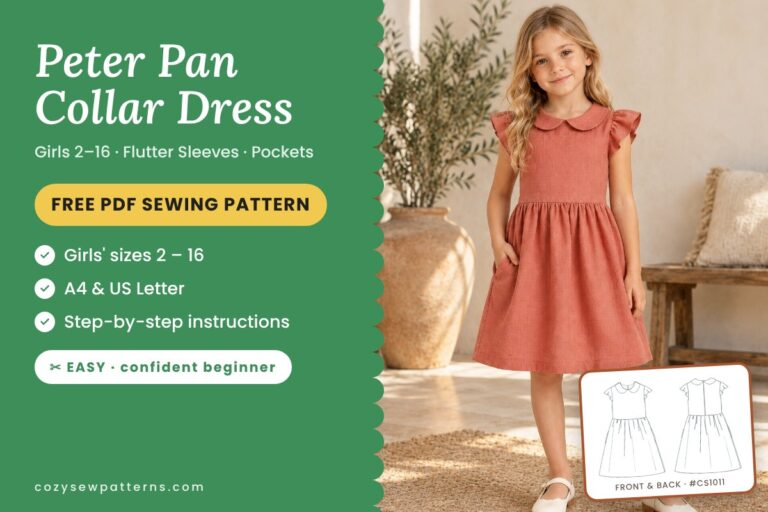
- Mother and daughter: sew our women’s Corduroy Pinafore Dress for a matching look, or try the Girls Peter Pan Collar Dress next.
Care
Wash inside out at 30–40 °C with similar colours, reshape while damp and press with steam. Check the straps after each wash.
Questions
Is the pattern really free?
Yes. The A4 and US Letter pattern files are free. The illustrated step-by-step guide and the A0 file are available for a small coffee.
Is it suitable for beginners?
Yes. There are no buttons, no zipper and no waist seam. The only fiddly parts are turning the narrow straps and stitching the facing corners, and both are explained step by step. A loop turner helps a lot.
Which size should I sew?
Measure the child’s chest and choose the size from the chart, then check the length against the height. The chest has very little ease, so between two sizes, or for wearing over a sweater, take the larger one.
What seam allowance is included?
1 cm (3/8″) on all seams and a 2 cm (3/4″) hem. The patch pockets have 1.5 cm (5/8″) on the sides and lower edge and a 2 cm (3/4″) hem at the top; the straps 1 cm all round. All are included.
Are both size groups included?
Yes. Sizes 2–6 and 7–16 are in the same download, so you can sew matching dresses for sisters of different ages.
Which paper sizes can I print?
A4 and US Letter are free to download, one file per size. The A0 file comes with the illustrated guide.
What can I sew next?
For a dress with sleeves, try our Peter Pan Collar Dress #CS1011. For matching mother-and-daughter outfits, our women’s Corduroy Pinafore Dress #CS1010 is free too.
Happy sewing!