Corduroy is the fabric of autumn: soft, warm, hard-wearing and full of texture. It is also one of the friendliest fabrics to sew once you know two things about it. It has a nap, so it changes colour depending on the direction you look at it, and its raised pile crushes easily under a hot iron.
This guide walks you through how to sew with corduroy from start to finish: which type to buy, how to prepare and cut it, which needle and stitch to use, how to press it, and which free patterns to try first.
What is corduroy?
Corduroy is a woven fabric, usually cotton or a cotton blend, with raised ridges of cut pile called wales (or cords) running along the length of the fabric. Because the pile fibres all lean the same way, corduroy looks lighter from one direction and deeper from the other: that is the nap.
The wale count tells you how many ridges there are per inch. The higher the number, the finer the ribs:
| Type | Wales per inch | Feel | Best for |
|---|---|---|---|
| Needlecord / pinwale | 16–21 | Fine, soft, drapey | Shirts, blouses, dresses, kids’ clothes |
| Standard (mid) wale | 11–14 | Classic corduroy | Pinafores, skirts, trousers, overshirts |
| Wide wale / jumbo cord | 3–10 | Thick, bold ribs | Jackets, coats, bags, cushions |
Choosing your corduroy
- Start with medium weight. Needlecord and 11-wale cord are easy to handle on a home machine. Wide-wale cord makes plackets, facings and buttonholes very bulky.
- Check for stretch. Many corduroys contain 1–3% elastane. A little stretch is comfortable in trousers and fitted dresses, but follow the pattern’s fabric advice: patterns drafted for wovens without stretch can feel loose in a stretchy cord.
- Buy a little extra. Corduroy must be cut “with nap”, which uses more fabric than a mixed layout. Patterns that are designed for corduroy usually already include this; otherwise add about 10%.
Prewashing and preparing
Cotton corduroy can shrink 3–5% the first time it is washed, so always prewash it the way you will wash the finished garment. Turn it inside out, wash at 30°C (86°F) on a gentle cycle and dry it flat or on a low tumble setting. High heat leaves pale lines in the pile.
When it is dry, give it a shake, smooth it with your hand in the direction of the nap and check that the cords run straight along the grain.
Cutting corduroy with the nap
Hold your corduroy up and stroke it. One way feels smooth (pile pointing down), the other way feels slightly rough (pile pointing up). With the pile pointing up, the colour looks richer and deeper; pointing down, it looks lighter and shinier. Either is fine, as long as every piece points the same way.
- Mark the top of the fabric with a chalk arrow or a safety pin so you never lose track of the nap direction.
- Use a “with nap” layout: place every pattern piece with its top edge towards the same end of the fabric.
- Lay the grainline arrows parallel to the cords.
- For accuracy, cut thick corduroy on a single layer, flipping the pattern piece over for the mirrored pieces.
- Mark notches and dots with tailor’s chalk, tailor’s tacks or small snips. Pen marks disappear in the pile.
Machine settings and sewing
| Setting | What to use |
|---|---|
| Needle | Universal 90/14; jeans 100/16 for thick or wide-wale cord |
| Stitch length | 2.5–3 mm for seams, 3–3.5 mm for topstitching |
| Thread | All-purpose polyester |
| Presser foot | Walking foot if you have one; otherwise reduce the presser-foot pressure |
| Pins | Pin inside the seam allowance, or use sewing clips |
- Stop the layers creeping. Pile against pile tends to slide, so the top layer “walks” ahead. A walking foot solves it. Without one, pin every 5 cm (2″) and sew slowly.
- Sew in the direction of the nap where you can, usually from the top of the seam down to the hem.
- Test first. Sew a seam and a buttonhole on scraps of your fabric, with interfacing, before you start.
Pressing corduroy without crushing it
Corduroy hates a heavy iron. Pressed flat on the right side, the pile is crushed and leaves shiny marks that are hard to remove.
- Press only from the wrong side.
- Lay the fabric face down on a fluffy towel or on a scrap of corduroy placed pile-up, so the ribs sink into it instead of being flattened.
- Use steam and a light touch: lift and lower the iron, never slide it.
- For crisp seams, press the seam open with your fingers and the point of the iron, then let the fabric cool before moving it.
Seam finishes, bulk and hems
- Finish every edge. Corduroy frays a lot. Serge or zigzag the seam allowances as you go.
- Reduce bulk. Grade (trim to different widths) the seam allowances inside facings and collars, and cut pocket bags from a lightweight cotton instead of cord.
- Interface carefully. Use a lightweight fusible woven interfacing with a press cloth, and press without sliding.
- Hems: a simple turned-up hem, machine-stitched or blind-stitched by hand, is all you need.
Free corduroy sewing patterns
Ready to try it? These free patterns all look great in corduroy:
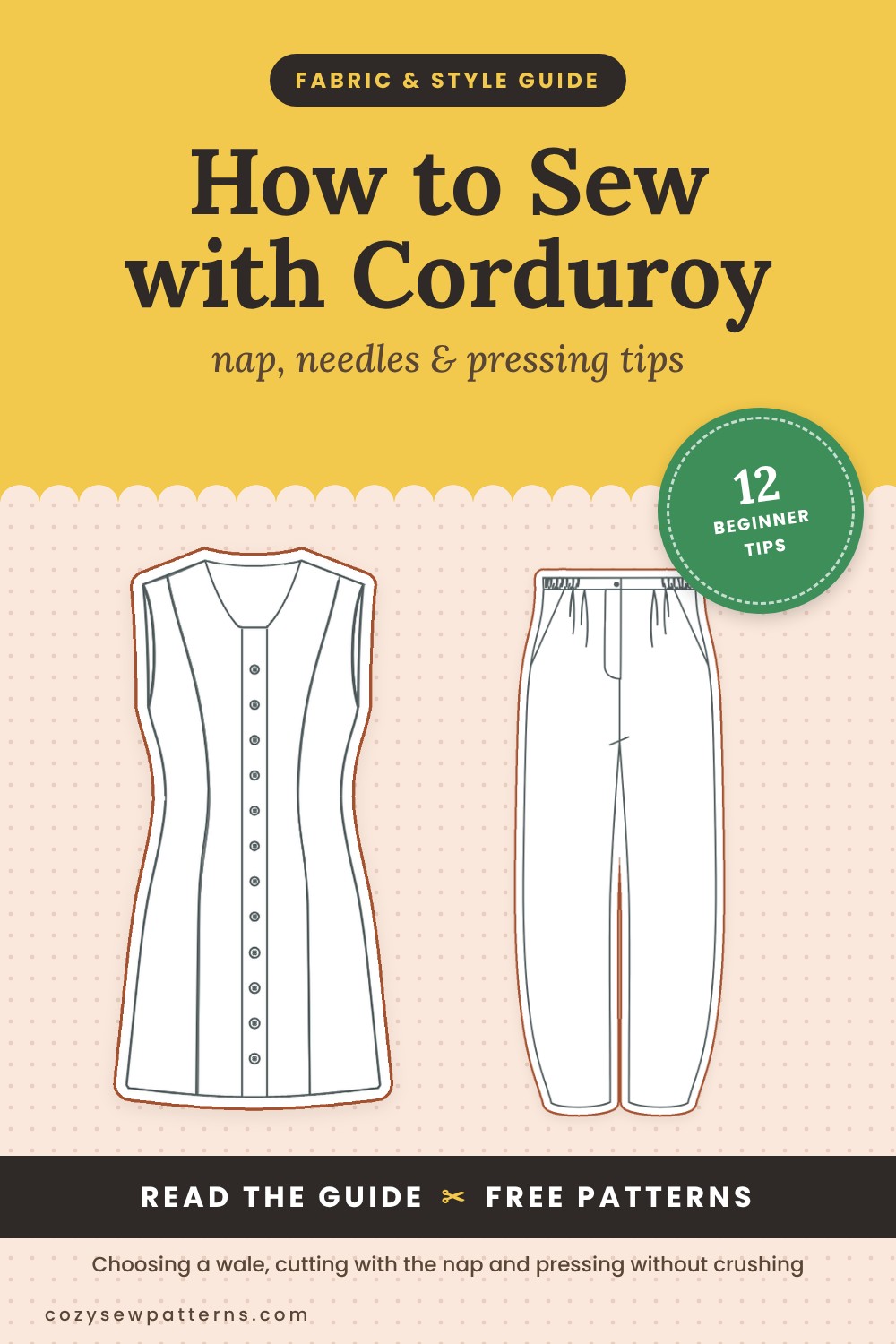
- Corduroy Pinafore Dress #CS1010: a button-front pinafore with princess seams, designed for corduroy. Easy level.
- Barrel Leg Pants #CS1006: relaxed pleated trousers with an elastic back, lovely in 11-wale cord.
- High-Waisted Barrel Trousers #CS1009: the tailored version with a straight waistband.
Sew your first corduroy pinafore
Our free Corduroy Pinafore Dress comes in sizes XXS–4XL, with a size chart, fabric chart and pattern piece list, in A4 and US Letter.
Need more help? Read How to Read a Sewing Pattern before you cut.
Frequently asked questions
Which way should the nap go on corduroy?
Either way works, as long as every piece points in the same direction. With the pile running up, the colour looks deeper and richer; with the pile running down, it looks lighter and slightly shiny.
Do I need to prewash corduroy?
Yes. Cotton corduroy can shrink 3–5%. Wash it inside out at 30°C (86°F) and dry it on low heat or flat before cutting.
What needle should I use for corduroy?
A universal 90/14 needle works for needlecord and standard corduroy. Use a jeans 100/16 needle for thick or wide-wale cord.
Is corduroy good for beginners?
Yes, needlecord and medium-wale corduroy are stable and easy to sew. Just remember to cut all pieces with the nap in the same direction and press only from the wrong side.
Happy sewing!