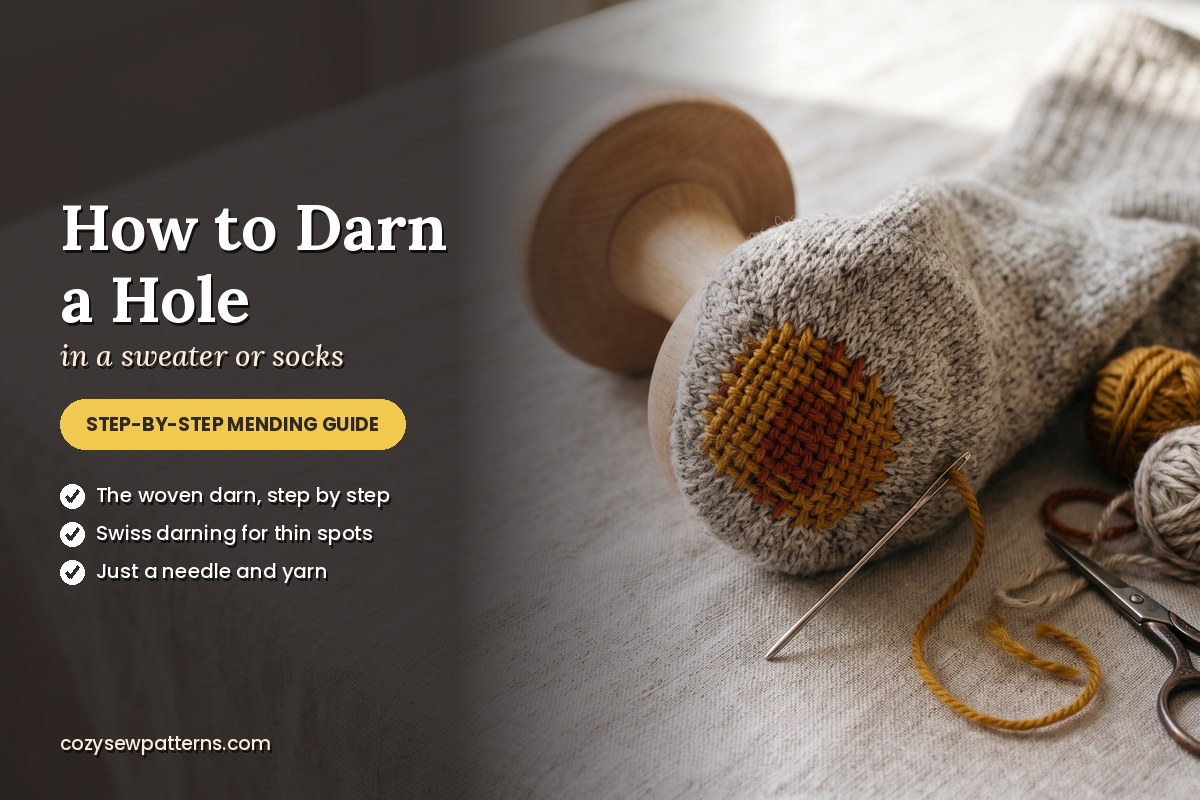
A moth hole in a wool jumper or a worn heel on your favourite socks does not have to send them to the bin. Darning is the old, simple art of re-weaving a hole with needle and yarn, and it takes less time than you think.
You can make your darn almost invisible with a matching yarn, or make it part of the design with a bright contrast colour. Either way, here is how to darn a hole step by step.
What you need
- Yarn of the same weight (or slightly thinner) than the knit. Wool for wool, cotton for cotton. Leftover knitting yarn or tapestry wool is perfect.
- A blunt darning or tapestry needle with a big eye. A blunt tip slides between the knit stitches instead of splitting them.
- A darning mushroom or egg to hold the area taut. A light bulb, an orange, a jam jar lid or a tennis ball works too.
- Small scissors and, if you like, an elastic band to hold the fabric on the mushroom.
Which darn should you use?
| Problem | Best repair |
|---|---|
| A real hole (up to about 3 cm / 1 1/4″) | Woven darn |
| A thin, worn area that has not broken yet | Swiss darning (duplicate stitch) |
| A large hole or torn woven fabric | A patch with sashiko stitching |
The woven darn, step by step
- Turn the garment right side out and slide the darning mushroom under the hole. Gently stretch the fabric over it, without distorting the knit, and hold it with an elastic band.
- Outline the area. With a running stitch, sew a square or circle around the hole about 1 cm (3/8″) into the sound fabric. This marks where your darn will go and reinforces the weak edge.
- Lay the vertical threads (the warp). Starting at one corner of the outline, take a small stitch into the fabric, cross the hole and take another small stitch on the opposite side. Turn and come back, laying parallel threads close together across the whole area, like the strings of a harp. Leave a tiny loop at each turn so the darn can stretch.
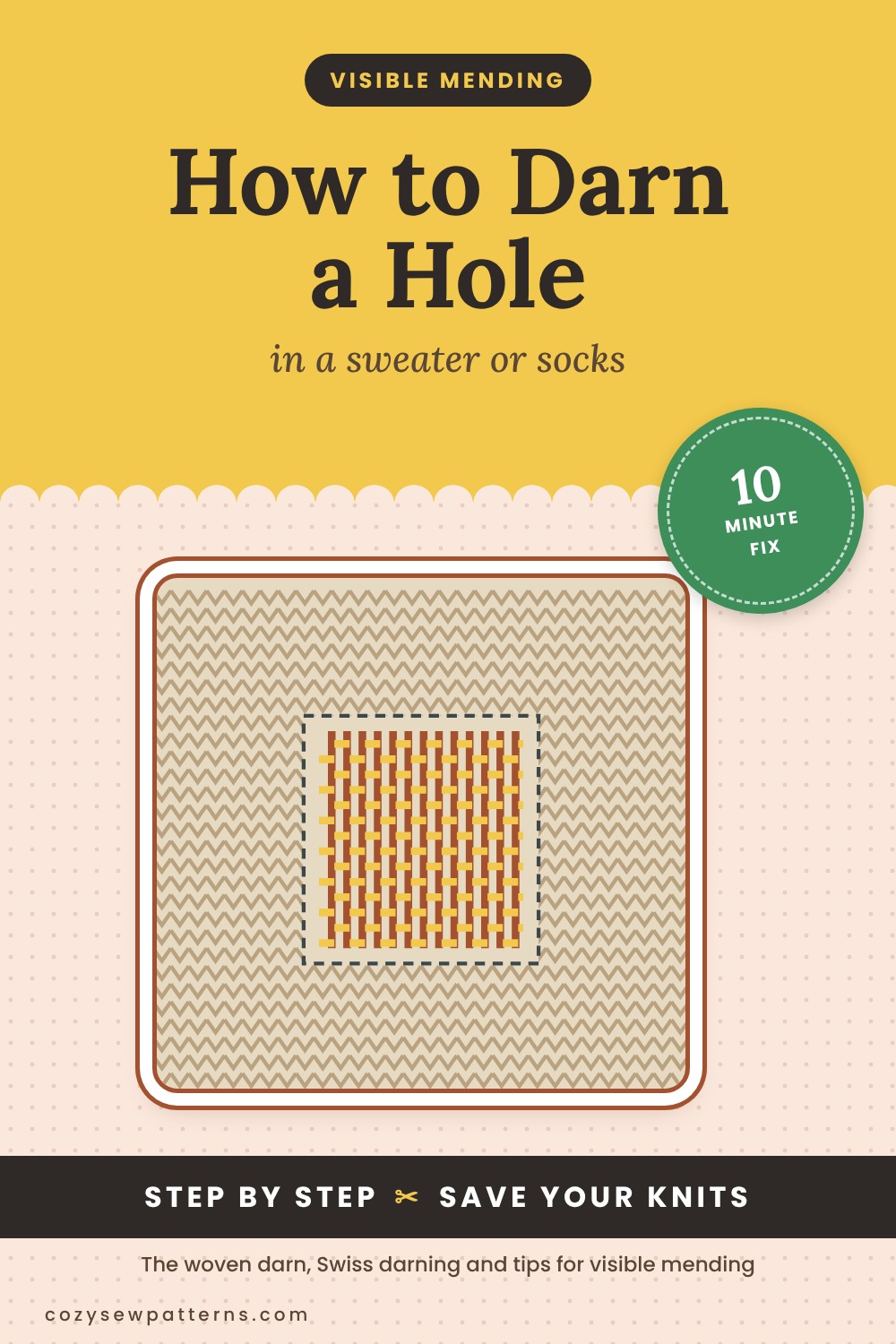
- Weave the horizontal threads (the weft). Turn the work 90°. Now weave across the vertical threads: over one, under one, all the way across. On the next row, go under the threads you went over before. Push each row up against the last with the needle.
- Keep going until the whole outlined area is filled with a firm little piece of woven fabric.
- Finish by weaving the yarn tail through the back of the knit for 2–3 cm (1″), then trim. No knots: they rub and make holes.
- Steam it. Remove the mushroom and press lightly with steam to settle the darn into the knit.
Swiss darning for thin spots
Swiss darning, also called duplicate stitch, copies the knit stitches with new yarn on top of the worn ones. It is perfect for elbows and sock heels that are getting thin but have no hole yet:
- Bring the needle up at the base of a knit “V”.
- Slide it from right to left behind the two legs of the stitch above.
- Go back down where you came up, at the base of the “V”.
- Repeat along the row, then work the next row above, until the thin area is covered.
Tips for a neat darn
- Darn early. A small hole takes ten minutes; a big one can take an evening.
- Do not pull tight. A darn that is tighter than the knit around it puckers and makes a new hole beside it.
- Go beyond the hole. The fabric around a hole is usually thin, so always cover it too.
- Socks: use a thinner yarn than the sock so the darn is not lumpy under your heel.
- Moth holes: wash or freeze the garment for 48 hours before mending, to make sure no larvae are left.
More mending and upcycling
Keep your clothes going for longer with these guides.
Frequently asked questions
What do I need to darn a hole?
Yarn of the same weight as the garment, a blunt darning or tapestry needle and something round to stretch the fabric over, like a darning mushroom, a light bulb or an orange.
Can I darn without a darning mushroom?
Yes. Any smooth, round object works: a light bulb, a tennis ball, an orange or the bottom of a glass jar.
How do I make a darn invisible?
Use yarn of the same colour, fibre and weight as the garment, keep the darn the same tension as the knit and steam it lightly when you finish.
Can you darn a hole in a cotton T-shirt?
Yes, with a fine cotton thread or embroidery floss and the same woven darn method. For larger holes in jersey, a small patch stitched on is usually easier.
Happy sewing!